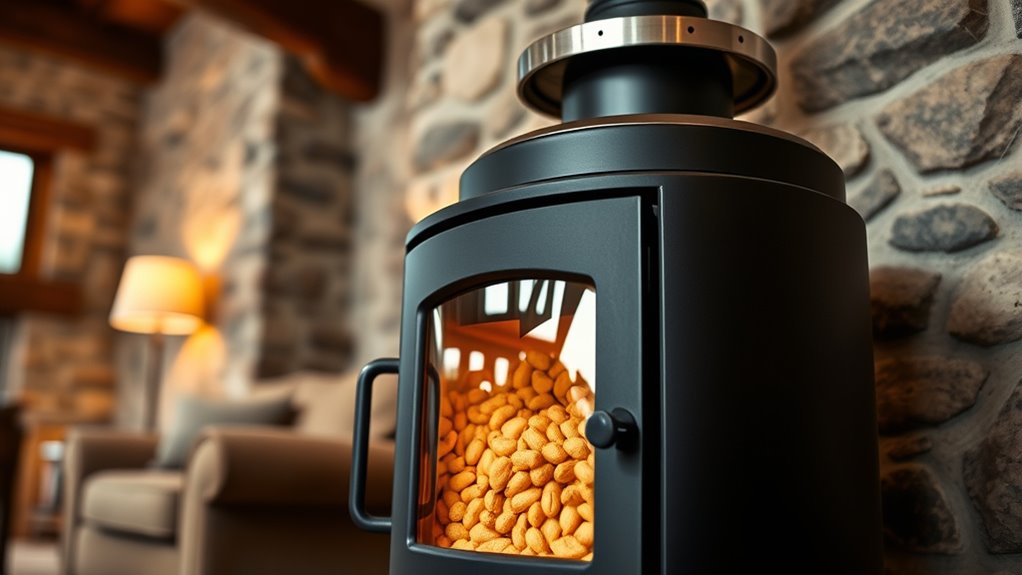

If you want pellet heat that can operate through a power outage, I would start with the US Stove GW1949 Wiseway for its documented 40,000 BTU output and 2,000-square-foot heating-area claim. The second Wiseway Non Electric Pellet Stove is the more appealing pick if you prioritize silent, no-moving-parts operation and its stated burn time of up to 36 hours. Both use a 60-pound hopper and gravity feed, so the choice is less about basic capacity than about which specifications are documented and how much control you expect.

Get backup power and energy gear delivered free with Prime
- Fast, free delivery on millions of items
- Prime Video, Amazon Music and more included
- Member-only deals all year
The tradeoff is straightforward: these are not push-button pellet appliances. Both require manual ignition with a propane torch, venting, and acceptance of a gravity-fed burn that offers less control than an electrically powered stove. I rank the GW1949 first because its output and coverage details are clearer; I rank the other Wiseway second for its stated longer burn time, while treating that figure cautiously because its listing gives fewer operating specifications.
Key Takeaways
- GW1949 is my clearest all-around choice: it lists 40,000 BTUs and heating coverage up to 2,000 square feet, while the other listing does not provide an output rating.
- Both stoves hold 60 pounds of pellets and use gravity feed, making them relevant to off-grid or blackout-prone spaces where electric ignition and powered feed are unwanted.
- The listed burn-time claims differ: GW1949 says up to 30 hours, while the second Wiseway says up to 36 hours; actual runtime depends on burn settings, fuel, and conditions.
- Neither is a hands-off appliance: both require manual lighting with a propane torch and a correctly vented installation.
- Choose by documentation and operating priorities: GW1949 has more published heating details; the second Wiseway emphasizes quiet operation and fewer moving parts.
| US Stove GW1949 Wiseway Non-Electric Pellet Stove |  | Best Overall — strongest published heating details | Brand and model: US Stove GW1949 | Heating area claim: Up to 2,000 sq. ft. | Hopper capacity: 60 lbs | VIEW ON AMAZON | See Our Full Breakdown |
| Wiseway Non Electric Pellet Stove |  | Best for Quiet, Extended Burns — with fewer published heating details | Model: Wiseway Non Electric Pellet Stove | Operation: Gravity feed; no electricity required | Hopper capacity: 60 lbs | VIEW ON AMAZON | See Our Full Breakdown |
| gravity feed pellet stoves non electric | Hopper capacity | Stated burn time | Brand and model | Heating area claim |
|---|---|---|---|---|
| US Stove GW1949 Wiseway Non-El | 60 lbs | Up to 30 hours | US Stove GW1949 | Up to 2,000 sq. ft. |
| Wiseway Non Electric Pellet St | 60 lbs | Up to 36 hours | — | — |
More Details on Our Top Picks
US Stove GW1949 Wiseway Non-Electric Pellet Stove
I put the US Stove GW1949 first because it gives buyers more concrete information for matching a stove to a space: a listed 40,000 BTU output and coverage claim up to 2,000 square feet. Those figures do not guarantee that it will heat every room of that size, but they make this a more straightforward choice to assess than the second Wiseway, whose supplied listing omits both output and area.
Its 60-pound hopper and stated burn time of up to 30 hours suit owners who want fewer pellet refills than a small-capacity unit may require. That runtime is shorter than the other model’s advertised up-to-36-hour figure, so I would not choose the GW1949 on duration alone. The advantage is a better-defined heating profile, not a proven performance lead under identical conditions.
Gravity feed means no powered pellet-feed system, which is the central reason to consider either stove for outage-prone or off-grid use. The tradeoff is a more hands-on routine: ignition requires a propane torch, and the feed design offers less adjustment than an electronically controlled stove. This is also a vented appliance, with the supplied specifications listing 3-inch venting; buyers need to plan installation rather than treat it as a portable heater.
Compared with the second Wiseway, the GW1949 is the safer pick for someone who wants documented output and coverage before making a heating plan. Choose the other model if its stated longer burn time and silent-operation emphasis matter more than missing capacity details. I would skip this one if you want automatic ignition, fine burn-rate controls, or heat without venting.
Pros:- No electricity required for its gravity-feed operation
- Lists 40,000 BTUs and heating coverage up to 2,000 square feet
- 60-pound hopper with stated burn time up to 30 hours
- 3-inch venting specification and alloy-steel construction are listed
Cons:- Requires manual lighting with a propane torch
- Vented installation limits where it can be placed
- Listed runtime is shorter than the other Wiseway’s stated up-to-36-hour claim
Best for: Buyers who want a non-electric gravity-feed stove with published BTU output, a stated heating-area claim, and a 60-pound hopper.
Not ideal for: People who need automatic ignition, precise electronic burn controls, an unvented heater, or a guaranteed heating result for a specific floor plan.
- Brand and model:US Stove GW1949
- Heating area claim:Up to 2,000 sq. ft.
- Hopper capacity:60 lbs
- Stated burn time:Up to 30 hours
- Venting:3-inch venting; vented installation
- Material:Alloy steel
- Dimensions and weight:24 in. D × 15 in. W × 52 in. H; 131 lbs
Our verdict“I recommend the GW1949 for buyers who value clearer heating specifications over the second Wiseway’s longer advertised runtime.”
Wiseway Non Electric Pellet Stove
The second Wiseway Non Electric Pellet Stove is the better fit if your priorities are quiet operation and a longer stated interval between refills. Its listing claims up to 36 hours from a 60-pound hopper, compared with up to 30 hours for the GW1949. That difference may matter in a cabin or workshop where frequent attention is inconvenient, but I would treat both figures as conditional claims rather than fixed runtimes.
The listed silent operation and lack of moving parts align well with the appeal of a gravity-fed stove: there is no powered feed mechanism creating operating noise. Against the GW1949, though, this model provides less information for sizing a heater. No BTU rating, heating-area claim, vent size, or material is supplied here. If I needed to estimate whether a particular room would receive enough heat, I would prefer the GW1949’s more complete specification set.
Its shared 60-pound capacity and stated 131-pound weight put it in much the same practical category as its counterpart: substantial enough to require planning for delivery and placement, rather than casual repositioning. The described compact dimensions and small clearances may help with layout, but I would verify the manufacturer’s installation instructions and required clearances for the exact unit and site. A compact footprint does not remove venting or safety requirements.
Like the GW1949, this stove requires manual propane-torch ignition and relies on gravity feed, so it is not the choice for someone expecting thermostat-like control or simple electric-start convenience. I would select it over the GW1949 only when quiet operation and its longer advertised burn-time claim carry more weight than documented output and coverage. For a heating plan that depends on known capacity, the GW1949 remains my more defensible recommendation.
Pros:- Operates without electricity using gravity feed
- Lists a 60-pound hopper and up to 36 hours of burn time
- Described as silent, with no moving parts
- Compact dimensions are listed, with small clearances noted in the product description
Cons:- Listing does not provide BTU output or heating-area coverage
- Manual ignition requires a propane torch
- At 131 pounds, it can be difficult to move into position
Best for: Off-grid or outage-prone buyers who value silent operation and want to prioritize the stated up-to-36-hour burn-time claim.
Not ideal for: Buyers who need published BTU output or heating-area coverage to size a stove, or who want powered ignition and precise burn-rate adjustment.
- Model:Wiseway Non Electric Pellet Stove
- Operation:Gravity feed; no electricity required
- Hopper capacity:60 lbs
- Stated burn time:Up to 36 hours
- Operation noise:Silent operation claimed
- Moving parts:None, according to the product description
- Dimensions:52 in. H × 24 in. W × 15 in. L
- Weight and color:131 lbs; black
Our verdict“I would choose this Wiseway over the GW1949 for quiet operation and its longer stated runtime, but not when documented heating capacity is the deciding factor.”
How We Picked
I ranked these two models for one specific job: providing pellet heat without relying on electricity for the feed system or normal operation. That makes gravity-feed design, hopper capacity, stated runtime, and installation requirements more useful comparison points than smart controls or powered features, which are not part of the supplied descriptions.
The GW1949 ranks first because its listing supplies an output figure, a heating-area claim, vent size, material, and other details that help a buyer plan a space. Its stated runtime is shorter than the second model’s, but the more complete specifications make its capabilities easier to evaluate. The other Wiseway earns a distinct role for buyers drawn to its stated up-to-36-hour burn and silent operation, although the listing does not give BTU output or heating coverage.
I also treated advertised runtime and area as manufacturer-provided claims rather than guarantees. Pellet quality, draft, installation, fuel rate, and the space itself can change results. Neither product description establishes that every installation is suitable for every building, so I would confirm clearances, venting, local code, and installation instructions before purchasing.
| gravity feed pellet stoves non electric | Stated burn time |
|---|---|
| US Stove GW1949 Wiseway Non-El | Up to 30 hours |
| Wiseway Non Electric Pellet St | Up to 36 hours |
Factors to Consider When Choosing Gravity Feed Pellet Stoves Non Electric
For this pair, I would focus less on broad feature lists and more on the practical limits of gravity-fed, non-electric heating. Both options share a 60-pound hopper, manual torch lighting, and a substantial 131-pound listed weight. Their meaningful differences are the supplied heating data, stated runtime, and how much uncertainty you can accept when planning installation.
Match published heat information to your space
The GW1949 lists 40,000 BTUs and coverage up to 2,000 square feet; the other Wiseway listing gives no BTU or area figure. That makes the GW1949 easier to compare with your heating needs, but an area claim is not a promise that it will heat every layout equally. Insulation, ceiling height, room divisions, climate, and placement all affect results. If you are considering the second model, ask the seller or manufacturer for applicable output and sizing guidance rather than filling in the missing information by assumption.
Read burn-time claims as estimates
The supplied listings state up to 30 hours for the GW1949 and up to 36 hours for the second Wiseway, each with a 60-pound hopper. The longer figure gives the second stove an advertised advantage, not proof that it will run six hours longer in a particular home. Burn rate, pellet quality, draft, and operating conditions affect consumption. If refill intervals matter, treat maximum runtime as a planning reference and confirm how the stove is expected to be operated.
Account for manual operation
Both choices avoid dependence on electricity for pellet feeding, but neither is an automatic, push-button heater. The descriptions specify ignition with a propane torch, and gravity feed can offer less control over burn rate than an electronically managed unit. That tradeoff may suit a buyer who values operation during outages and accepts a more involved routine. It is a poor match if you want automatic ignition, tightly controlled output, or minimal interaction once the stove is running.
Plan venting and placement before buying
The GW1949 listing specifies 3-inch venting and says the stove is limited to vented installation. The second description mentions compact dimensions and small clearances, but does not provide a vent-size specification in the supplied details. Both models weigh 131 pounds, so placement is a real installation task. Check the exact manual for vent requirements, clearances, floor protection, and local code, and arrange suitable help for moving the stove. Do not infer that compact dimensions make an installation simple or universally permitted.
Choose the model whose tradeoff fits
I favor the GW1949 when certainty about listed capacity matters, since its output and coverage claims help buyers start a sizing conversation. The second Wiseway makes more sense when the quiet-operation description and up-to-36-hour runtime claim are the priorities, and the missing output details can be confirmed before purchase. If neither model’s manual controls and vented setup suit your household, an electric-start pellet stove or another heating type may be a better fit, even if it depends on power.
Frequently Asked Questions
Do these gravity-feed pellet stoves need electricity?
Both product descriptions identify the stoves as non-electric and say they use gravity feed, making them relevant to off-grid sites and power outages. That describes their pellet-feed operation; it does not remove the need to follow the manufacturer’s lighting and operating directions. Neither listing describes automatic electric ignition, and both specify manual lighting with a propane torch.
Which model has the longer listed burn time?
The second Wiseway listing claims up to 36 hours, while the US Stove GW1949 listing claims up to 30 hours. Both have a stated 60-pound hopper. I would use those figures as advertised maximums rather than guaranteed runtimes, since fuel, draft, burn rate, and installation conditions can change how long a load lasts.
Which stove is easier to size for a room?
The GW1949 is easier to evaluate from the supplied information because it lists 40,000 BTUs and a heating-area claim of up to 2,000 square feet. The second Wiseway listing does not include either figure. Even with the GW1949, I would confirm suitability for the specific building with the manufacturer or installer; room layout, insulation, and climate affect heating performance.
Are either of these stoves suitable without a vent?
No vent-free use is established by the supplied product details. The GW1949 is specifically described as requiring vented installation and lists 3-inch venting. The second listing does not state a vent size, so I would consult its official manual before planning an installation. Check applicable building and fire codes rather than assuming either model can be used without a proper vent.
Which one should I choose for an off-grid cabin?
I would choose the GW1949 if the cabin’s heating plan depends on having a published output and area claim to review. I would consider the second Wiseway if silent operation and its stated up-to-36-hour burn time matter more, after confirming its heating capacity and installation requirements. For either option, plan for torch ignition, pellet storage, safe venting, and the effort needed to position a 131-pound stove.
Conclusion
For most buyers comparing these two non-electric gravity-feed stoves, I recommend the US Stove GW1949 because its 40,000-BTU output and up-to-2,000-square-foot coverage claim give a clearer starting point for evaluating heat needs. If your main priority is quiet operation and the longer stated burn-time figure, the second Wiseway Non Electric Pellet Stove may suit you better, provided you verify its capacity before committing. Choose neither if manual torch ignition, limited burn control, a vented installation, or the weight and placement demands do not fit your home. In that case, I would compare other heating options rather than treating the no-electricity feature as the only deciding factor.