TL;DR
New York’s Public Service Commission approved two utility-scale thermal energy networks, in Haverstraw and Buffalo, with a combined project cost of $111.5 million. The pilots will test whether utilities can use underground and wastewater heat to serve buildings with electric heat pumps while limiting costs for customers and retaining utility work. The commission rejected nine other proposals, and the projects’ performance and final costs remain to be demonstrated.
New York’s Public Service Commission has approved two utility-scale thermal energy network projects in Haverstraw and Buffalo, authorizing a combined $111.5 million in planned investment to test systems that use underground and recovered heat to provide heating and cooling. The commission rejected nine other proposals, making the two projects a limited pilot rather than a broad rollout across the state.

Get backup power and energy gear delivered free with Prime
- Fast, free delivery on millions of items
- Prime Video, Amazon Music and more included
- Member-only deals all year
Orange & Rockland plans to spend $50 million in Haverstraw, a Hudson River town of about 40,000 people. The network is planned to connect as many as 30 buildings, including single- and multifamily homes, commercial and government properties, and an elementary school. It would draw heat from borefields drilled on municipal land and recover heat from the town’s wastewater system.
In Buffalo, National Fuel Gas plans to invest $61 million in a system serving low-income multifamily housing and linking with the city’s existing downtown steam network. The project would combine heat from boreholes and wastewater recovery, with the stated aim of displacing some fossil gas-fired boilers in the legacy district heating system. The source report says $93 million in state funds will offset costs to the utilities’ customers; those funds are part of a $150 million state commitment to thermal energy networks.
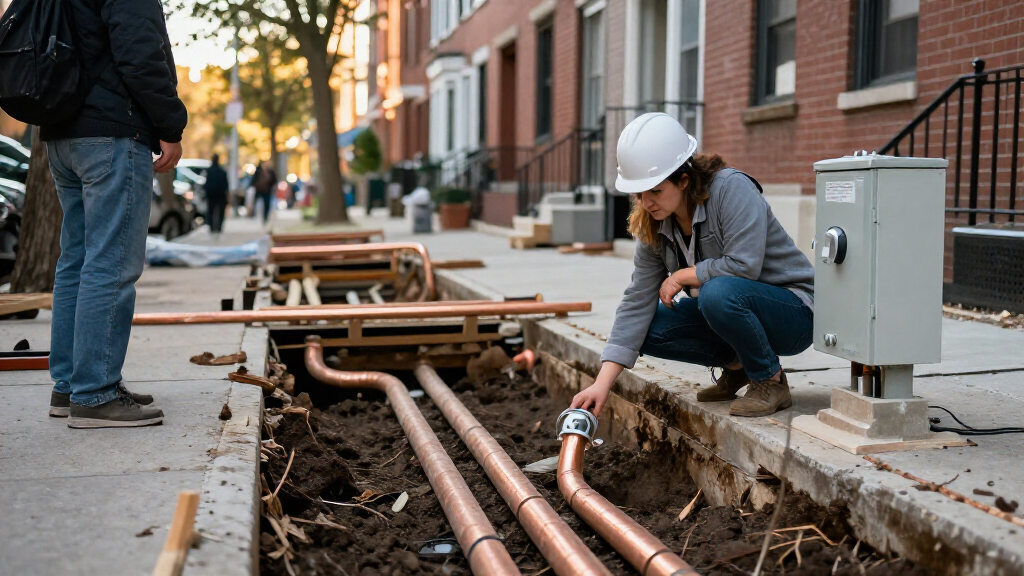
The networks circulate water or another fluid through pipes to capture relatively steady heat from underground or sources such as sewers and industrial facilities. That heat can improve the performance of electric heat pumps, which can replace gas furnaces and boilers. The projects are expected to move into further design work; approval does not establish that the systems have already been built or that their cost and performance have been proven.
Testing a Gas Utility Alternative
The approvals put New York’s effort to shift some utility activity from delivering fossil gas toward supplying clean heat into a practical test. The projects are intended to show whether existing utility expertise and underground infrastructure can support shared thermal systems, while providing a pathway for workers such as pipefitters and plumbers to remain involved in energy infrastructure work.
The cost question is central. State support is intended to limit the amount charged to utility customers, but the systems require substantial construction spending. The pilots can help regulators and utilities judge whether benefits such as lower fossil fuel use and more efficient heat pumps justify those costs. The source report does not provide projected customer bills, emissions reductions, or measured system efficiency.
Products Worth Considering

Levoit Eleva 300X Air Purifier with Sealed HEPA Filtration

Roborock Qrevo 2 Pro Robot Vacuum and Mop, 20,000 Pa Suction

Philips Hue Play HDMI Sync Box
As an affiliate, we earn on qualifying purchases.
Nine Proposals Did Not Advance
The approvals follow about four years of advocacy by UpgradeNY, a coalition of clean-energy, environmental and labor groups that has urged regulators to support utility thermal energy networks. Its proposal is to use networks based on renewable or recovered heat rather than continue expanding gas delivery infrastructure, while retaining utility investment and employment.
The commission’s decision was mixed: it approved Haverstraw and Buffalo but rejected nine other proposed networks, including projects in New York City and other upstate communities. According to the source report, building the rejected projects would have required utilities to collect about $1 billion from customers. The two approved projects are described as the second and third of their kind in the country, reflecting how early the approach remains in the United States.
““From a workers’ rights and environmental justice standpoint, it’s a win-win.””
— Theodore Moore, executive director of The Alliance for a Greater New York and a member of UpgradeNY
Costs and Results Still Unproven
The approvals do not settle whether the networks will deliver benefits large enough to justify construction and operating costs. The source report says it remains unclear how costs will compare with advantages for customers and the state’s climate goals. It gives no detailed schedule for construction or operation, no final customer-bill estimates, and no quantified emissions or efficiency targets for either project.
It is also not clear whether the state’s $93 million contribution will cover all intended customer cost offsets or how expenses will be allocated over time. The commission’s rejection of nine proposals leaves open whether additional projects could be reconsidered or proposed under different terms. Those issues will become clearer as project designs and financing plans develop.
Design Work Sets the Next Milestone
Orange & Rockland and National Fuel Gas are expected to advance the Haverstraw and Buffalo plans through further design. The next public details to watch for include final network layouts, construction schedules, the buildings and customers ultimately served, and how the state funds will reduce charges to utility customers.
After construction and operation begin, evidence on reliability, cost, heat recovery and fossil fuel displacement will determine how useful the pilots are as a model for other communities. No dates for those milestones are specified in the source report. Until results are available, the two approvals represent a test of the approach, not confirmation that utility thermal networks will be economical or widely adopted in New York.
Key Questions
Where will the two approved thermal networks be built?
One is planned for Haverstraw in the Hudson Valley and the other for Buffalo. The projects are led by Orange & Rockland and National Fuel Gas, respectively.
How much will the projects cost?
The utilities plan to spend $50 million in Haverstraw and $61 million in Buffalo, for a combined $111.5 million. The source report says $93 million in state funds will help offset costs to utility customers.
How do thermal energy networks provide heat?
They circulate water or another fluid through pipes to collect heat from sources such as underground boreholes and wastewater. The captured heat can support electric heat pumps serving nearby buildings.
Did New York approve all the proposed projects?
No. The Public Service Commission approved two proposals and rejected nine, including projects proposed in New York City and other upstate communities.
When will the projects be operating?
The utilities are moving into further design work, but the source report does not give construction or service start dates. Their cost and performance will need to be evaluated after the systems are built and operating.
Source: rss