

Disclosure: Gewerkton is built by our publisher — we build it ourselves and write down what we learn.

Get backup power and energy gear delivered free — and shop member deals
- Fast, free delivery on millions of items
- Access to Prime Big Deal Days deals on October 6–7
- Prime Video, Amazon Music and more included
On a construction site, what counts is what can be proven. Handover does not end that. Warranty periods keep running, inspections on the building come round again, and the file passes to people who were never on site. Gewerkton, the construction-site documentation platform our publisher builds, now has two lines for that period: Archive and Operations. Both are built and in beta, and neither has been in use at a customer yet.
Two lines for the years after the build
The website puts the idea in one sentence: “When a project ends, the duty to prove does not.” Archive turns the closing into a lasting state that is readable, exportable and unchangeable. Operations covers the other half. At handover, as the site puts it, the customer changes: no longer site management, but the owner, the property manager or facility management.
That makes five lines in all. Field captures on site, Studio brings plans into the browser, Cloud handles operations and region, Archive keeps the evidence after the project ends, and Operations carries the finished building on. All five work on the same evidence chain, not on five copies of it.
Closed is not deleted
Archive adds a third state next to active and suspended: archived. No deletion clock runs in that state. Permitted roles can still read, search and pull exports, even years later. A project can still be reopened: the way back into the active state is possible, documented and logged.
Writing, on the other hand, stops. Instead of a separate rule per table, there is one central lock at the entrance: for an archived project every writing path refuses, with a clear message in the content languages. The freeze has no exception. An archived project can no longer be changed, deleted or added to, not by the customer’s own admin and not by Gewerkton as the provider.
A check every year
Being unchangeable is only half of it; it also has to be shown. Once a year a run holds the checksums of the evidence chain against the originals and files the result as a timestamped report for each archived project. If something deviates, it is reported rather than passed over in silence. When originals move to cold storage they stay byte identical, and only the storage class gets cheaper. The trade-off is that a retrieval from cold storage can take minutes.
The check does not depend on Gewerkton. The holdings come with an index of every file, a checking tool that runs in the browser without a server or an account, and a letter that explains in plain language what the holdings are. That way the other party can recalculate a checksum themselves. Questions put to the archive are answered only where a record backs the answer, with the place it was found. Where no record exists, the answer says so instead of guessing.
Complete first, then closed
Before a project is archived, a closing assistant says plainly what is still missing: defects without a closing photo, notices never sent, company access still open. The completeness value is frozen with everything else. For a single defect there is the file at the push of a button: one document that bundles the photos with checksum and date, the correspondence, the deadlines and the plan reference.

The machine-readable summary on gewerkton.com lists further built pieces for Archive:
- a transparency log and sealed disclosure statements with checksums,
- the state of knowledge at a cutoff date,
- an evidence hold with four eyes release,
- intake of external legacy records with an honest label,
- secondary custody by a named third party.
The project becomes a building
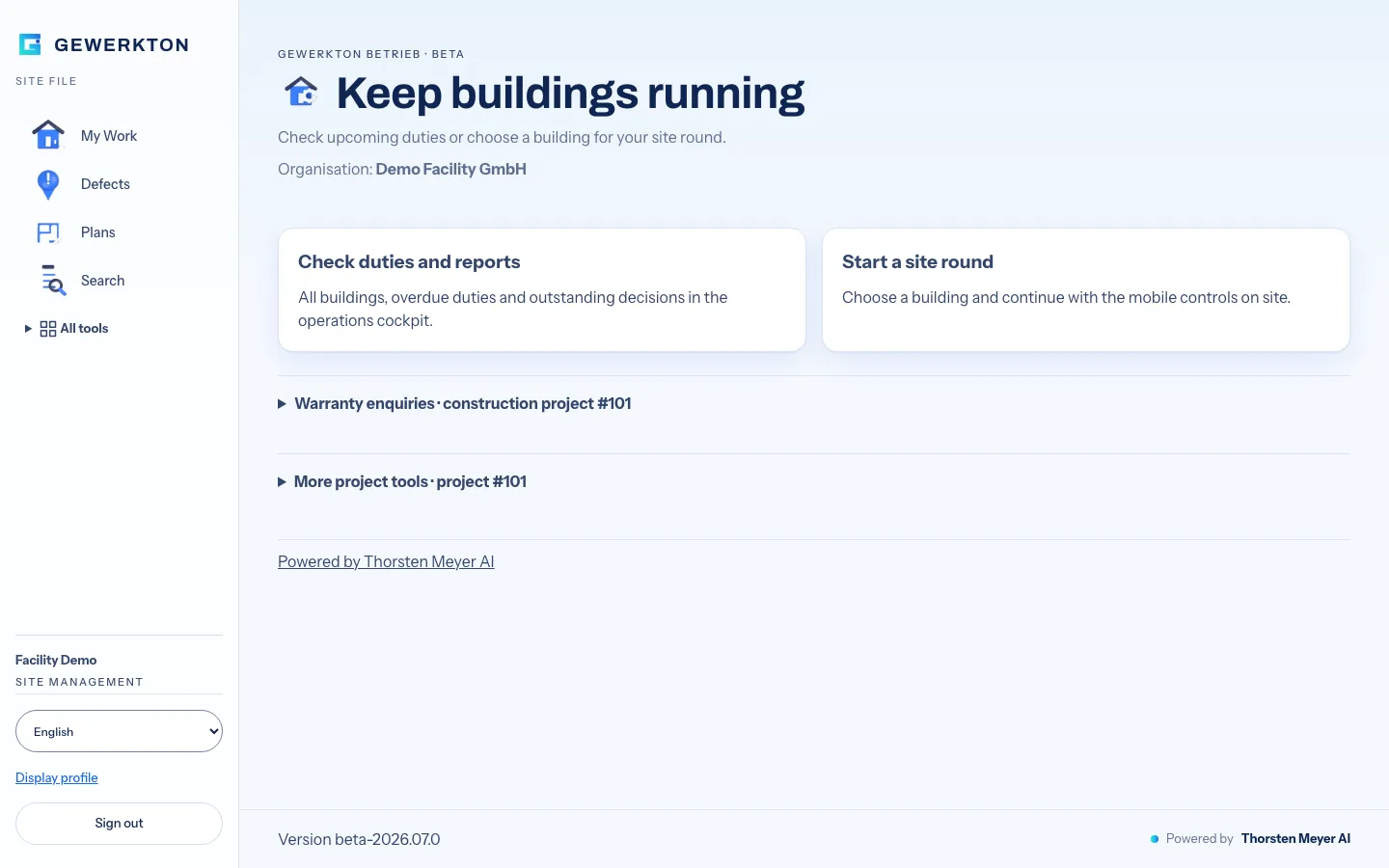
Operations starts where site management hands the finished building over. At handover the project becomes an entity of its own: the building or the asset, with a reference to the history of the construction phase. The evidence is not copied; the chain stays one. The handover record, asset register, room book and deadlines travel along.
Often a different organisation runs the building, such as a property manager or a facility management team. In that case the building is handed over by invitation, and the building organisation keeps its project and can archive it later. Handing over is not giving up: the handover copies, it does not move. Photos and records stay in the construction documentation, while the operator receives references with a checksum and sees only what was handed over. That separation sits in the database, not in a setting.
Warranty, inspections, maintenance
A warranty radar tracks deadlines per trade and acceptance. For every warranty period taken over, Operations calculates an inspection date some weeks before it ends and proposes it; if the date falls on a weekend, it moves. People walk the building and make the decisions.
Recurring inspections such as ventilation, lifts and fire protection are kept on the building. A maintenance job is evidenced like any other item, with a checklist, a photo and a signature, and assets, documents and history sit in one searchable building file. For winter service, every deployment records the daily value of the chosen weather station, so years later it can be shown what the day was really like. For a flat handover, move-in and move-out are recorded room by room with photos, and at move-out Operations places the earlier pictures beside the new ones.
Reporting without an app or an account
A reporting path runs from the user through the operator back to the organisation that built the building. A case arrives there with a reference to the original evidence chain rather than as a shout. Three paths run over simple links that work on any phone and speak the language they are given: the QR sticker in the hallway for tenants, the warranty report back to the building company, and the maintenance report from an outside firm.
According to the summary on gewerkton.com, Operations also has these pieces built:
- a full building export as ZIP,
- an asset life story that carries a replacement along,
- a register of deviations between reality and the handover state,
- insurance requirement excerpts quoted with their source,
- a four eyes chain of delegated duties,
- a work permit for external companies via a token link.
What the two lines are not
Gewerkton draws the limits itself. Operations is not a full CAFM system: space management, contracts and keys stay out of scope, and existing CAFM systems get an export. Archive is reading only; deadlines, inspection cycles and reporting paths after handover belong to Operations. Both pages state plainly that they say nothing about approval or legal effect.
Where things stand: built, in beta, not yet at a customer
Archive and Operations are built and in beta, but neither has been in use at a customer yet. That is exactly how the website puts it on both pages. For Gewerkton, 2026 is the beta year, and general availability is planned for 2027; the site calls that a plan and not a promise. The screens in this article are real screens of the web app, filled with a fictional demo project.
Anyone who wants to freeze their own records early, or who takes over buildings and wants to help shape the reporting path, can join through the waitlist. The beta page shows where all five lines stand, and the Operations page lists what is built for the years after handover.
Halloween Picks
halloween
As an affiliate, we earn on qualifying purchases.