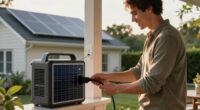
Choosing a solar backup system is less about deciding whether solar is useful than deciding how much of your home you need to keep running, and how much setup you will accept during an outage. A portable solar generator pairs a battery with an inverter and optional panels; a fixed home battery is installed as part of a home’s electrical system, often alongside rooftop solar. Both can store solar energy for later, but they serve different outage plans.

Get backup power and energy gear delivered free with Prime
- Fast, free delivery on millions of items
- Prime Video, Amazon Music and more included
- Member-only deals all year

ECO-WORTHY Solar Panel and LiFePO4 Home Backup System
- ✔ Usable energy: 30kWh+
- ✔ Battery configuration: Two 48V 314Ah LiFePO4 batteries
- ✔ Inverter: 10kW hybrid inverter

ECO-WORTHY 10 kW Off-Grid Solar System Kit with Split-Phase Inverter, Batteries, and Solar Panels
- ✔ Inverter output: 10,000W continuous; 20,000W peak
- ✔ Output voltage: 120V/240V split-phase
- ✔ Solar array: Nine 590W panels; 5,310W total
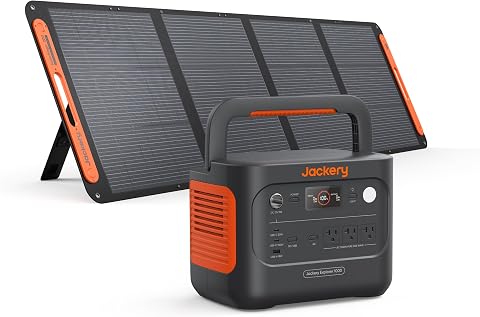
Jackery Solar Generator 1000 v2 with 200W Solar Panel
- ✔ Battery capacity: 1,070Wh
- ✔ AC output: 1,500W
- ✔ Surge peak: 3,000W
The portable option usually costs less to start, can move between locations, and works well for phones, lights, a router, and selected appliances. The fixed system costs more and calls for professional installation, but can switch over automatically and power selected household circuits or, with adequate equipment, much of the home. Choose based on backed-up loads, outage duration, installation constraints, and whether the system must work without hands-on setup.
At a Glance
| Criteria | Portable solar generator system | Fixed home battery backup system | Winner |
|---|---|---|---|
| Upfront cost and installation | Usually lower initial cost; typically plug-and-play, though panels and accessories add expense. | Higher installed cost; may require electrical work, permits, and compatible equipment. | A |
| Power and capacity | Capacity and output vary widely; suited to selected devices and appliances, not automatically an entire home. | Scalable systems can support selected circuits or broader household loads, subject to inverter output and battery capacity. | B |
| Outage convenience | Requires manual connection and load management; no automatic household switchover in a typical setup. | Can provide automatic backup when configured with transfer equipment; loads can be managed through the system. | B |
| Solar recharging | Can recharge from compatible portable panels; speed depends on sunlight, panel input limits, and battery size. | Can recharge from rooftop solar when the system is configured for backup operation; availability depends on design, sunlight, and power demand. | Depends |
| Portability and flexibility | Can be moved, stored, or used at a campsite or another location. | Fixed in place; not suited to travel or relocation without substantial work. | A |
| Home integration | Usually powers devices directly or through selected connections; circuit-level backup requires additional compatible equipment and careful planning. | Designed to connect with a home’s electrical panel and, in some cases, solar generation and energy management. | B |
| Best value | Best when a modest set of essential loads is enough and avoiding installation expense matters. | Best when reliable, hands-off home backup and broader circuit coverage justify the installation cost. | Depends |
ECO-WORTHY Solar Panel and LiFePO4 Home Backup System
This is our top choice when the goal is a substantial fixed solar backup system rather than a portable power station. Its 30kWh+ usable energy from two 48V 314Ah LiFePO4 batteries is the highest stated storage figure in this group, and the 10kW hybrid inverter with 120V/240V output places it in a different class from Jackery’s 1,500W AC output. That distinction matters for buyers planning a larger home or off-grid setup, though the system’s actual supported loads still depend on proper design and installation.The package includes six 590W panels, batteries, inverter, and cables, so it arrives as a coordinated system rather than a collection of separately selected core components. Compared with the other ECO-WORTHY kit, this model offers more stated usable energy, while the off-grid kit brings three additional panels and a clearly stated 5,310W panel total. Buyers weighing storage against generation should not assume one number guarantees better backup: battery reserve helps cover periods without sun, while panel capacity can help replenish energy when conditions allow.The tradeoff is scale. The panels measure nearly 90 by 45 inches each, the shipment requires truck delivery and an appropriate receiving address, and the inverter exterior version is selected randomly. Bluetooth, Wi-Fi, app, and LCD monitoring help with visibility, and listed safety equipment includes an active-balancing BMS, circuit breaker, aerosol fire suppression, and buzzer alarm. Even so, this is not a simple plug-in substitute for Jackery; we would choose it only with a clear installation plan and a suitable site.
Pros:
- 30kWh+ of stated usable battery energy, the largest figure in this lineup
- 10kW hybrid inverter supports 120V and 240V output
- Includes six 590W panels, batteries, inverter, and cables
- Monitoring options and multiple battery safety features are specified
Cons:
- Large panels and equipment require truck delivery and a suitable receiving address
- The inverter exterior version is selected randomly
- System scale makes installation planning more involved than with a portable power station
Best for: Homeowners or off-grid planners who want the lineup’s highest stated battery reserve, 120V/240V output, and a bundled large-system setup.
Not ideal for: Renters, buyers seeking a portable emergency station, or anyone without space, delivery access, and a plan for professional system integration.
Bottom line: We rank it first for buyers who need a large, integrated storage-oriented backup package and can manage its delivery and installation demands.
“We rank it first for buyers who need a large, integrated storage-oriented backup package and can manage its delivery and installation demands.”
ECO-WORTHY 10 kW Off-Grid Solar System Kit with Split-Phase Inverter, Batteries, and Solar Panels
This kit is the better match for buyers who want a defined off-grid package with nine 590W panels and a 10,000W inverter. Its 5,310W total panel capacity exceeds the six-panel Home Backup System’s listed array, while its 20.48kWh total storage is lower than that system’s 30kWh+ usable-energy claim. That gives the two ECO-WORTHY options distinct emphases: this kit puts more panel area into the package, while our top pick emphasizes a larger stated battery reserve.The inverter supports 120V/240V split-phase output, and the package includes four 48V 100Ah LiFePO4 batteries, cables, dual MPPT controllers, and monitoring. A stated 20,000W peak output is also listed, but we would make planning decisions around the continuous 10,000W rating and the actual demands of connected loads. Compared with Jackery, this is a fixed-system project rather than a movable backup box; compared with the other ECO-WORTHY product, it may better suit a buyer prioritizing a larger included solar array over maximum stored energy.Its main limitation is the work and space required to use it. The panels are large, ship by truck on a pallet, and professional installation is recommended. The listed battery total and inverter capacity do not by themselves establish how long a particular home will run, nor whether the system suits a specific electrical setup. We would verify load needs, site conditions, installation requirements, and component compatibility before choosing it. Built-in Wi-Fi and battery app monitoring add visibility, but they do not remove the need for careful system design.
Pros:
- Nine 590W panels provide 5,310W of stated solar capacity
- 10,000W continuous inverter supports 120V/240V split-phase output
- Includes four LiFePO4 batteries with 20.48kWh total storage
- Dual MPPT controllers and built-in monitoring are specified
Cons:
- Panels are large and delivered by truck on a pallet
- Professional installation is recommended
- Stated storage is below the 30kWh+ figure of the other ECO-WORTHY system
Best for: Off-grid buyers who value a larger included solar array, split-phase output, and a bundled inverter-and-battery kit.
Not ideal for: Anyone who needs a portable system, wants the highest stated storage capacity in this comparison, or cannot accommodate pallet delivery and professional installation.
Bottom line: We recommend it for an off-grid build where a nine-panel array and split-phase inverter matter more than maximizing battery storage.
“We recommend it for an off-grid build where a nine-panel array and split-phase inverter matter more than maximizing battery storage.”
Jackery Solar Generator 1000 v2 with 200W Solar Panel
Jackery is our pick for buyers who need backup that can move between home, a vehicle, and a campsite. At 23.8 pounds for the power station, with a 200W panel included, it is far easier to deploy casually than either truck-delivered ECO-WORTHY system. Its 1,070Wh LFP battery and 1,500W AC output can serve smaller appliances and multiple devices, but the capacity is a fraction of the home systems’ stated storage. We see it as a portable essentials solution, not a scaled-down whole-home equivalent.Three pure sine wave AC ports, two USB-C ports, one USB-A port, and a car port make it convenient for mixed-device charging. The 3,000W surge peak provides a brief starting margin for suitable loads, but buyers should still check appliance startup and running requirements rather than relying on the peak figure alone. Its LFP battery is rated to retain over 70% capacity after 4,000 charge cycles, and the app offers emergency, quiet, and energy-efficiency charging modes. Compared with the ECO-WORTHY kits, Jackery trades system scale and 120V/240V output for portability and a much simpler role.There are practical qualifications. The one-hour full-charge claim applies only when emergency charging is enabled in the app; the default stated time is 1.7 hours. The power station and panel also ship separately, so the bundle may not arrive as one shipment. For short outages, outdoor use, or selected electronics and appliances, those limits may be acceptable. If we needed multi-day household storage or a fixed split-phase installation, we would choose one of the ECO-WORTHY systems instead.
Pros:
- Portable 23.8-pound power station with a 200W solar panel included
- 1,070Wh LFP battery and 1,500W AC output suit selected essentials
- Multiple AC, USB, and DC ports support simultaneous device charging
- App includes emergency, quiet, and energy-efficiency charging modes
Cons:
- Battery capacity is far below either ECO-WORTHY home system
- One-hour full charging requires emergency mode; default stated time is 1.7 hours
- Power station and solar panel ship separately
Best for: Campers, travelers, and households seeking a movable backup station for electronics and selected smaller appliances.
Not ideal for: Buyers planning whole-home backup, 120V/240V split-phase service, or long runtimes for multiple high-demand appliances.
Bottom line: We choose Jackery when portability and straightforward backup for essentials matter more than household-scale storage or split-phase output.
“We choose Jackery when portability and straightforward backup for essentials matter more than household-scale storage or split-phase output.”
As an Amazon Associate we earn from qualifying purchases.
Key Differences
The defining difference is how backup power reaches your essential equipment. With a portable generator, you choose which devices to plug in and keep an eye on the remaining charge. That simplicity keeps the entry cost and commitment down, but means the system is not a substitute for whole-home backup. A fixed battery connects to household circuits through an installed electrical setup. It can take over selected loads with little or no action from you, but that convenience comes at a higher installed cost.
Capacity alone does not determine what a system can run. Battery capacity affects how long loads can operate, while inverter output affects which devices can run at once; motor-driven appliances may have high startup demand. For either option, check both ratings against the appliances you plan to back up. Solar panels can replenish either type in suitable conditions, but a solar-equipped system is not automatically outage-ready: grid-tied solar may shut down during a grid outage unless the inverter and battery configuration can operate independently.
That makes the choice a question of scope and responsibility. If you can manage a short list of devices and value mobility, a portable system is often the sensible first purchase. If outages affect heating controls, refrigeration, medical equipment, or daily home routines—and you want backup to engage automatically—a fixed system is usually the stronger fit. Before buying either, map the loads, expected outage length, and recharge conditions rather than relying on a headline capacity figure.
Detailed Comparison
Upfront cost and installation (Portable solar generator system wins — major)
Portable solar generator wins by a major margin on entry cost and installation simplicity. Many units can be used after basic setup, while a fixed battery commonly involves an electrician, permitting, transfer equipment, and possible panel upgrades. Portable systems still vary in price, and adding enough panels or expansion batteries can narrow the gap. In practice, choose portable when you want backup without committing to a home project; pay for fixed installation only when the added household integration solves a real need.
Power and capacity (Fixed home battery backup system wins — major)
A fixed system generally wins for sustained household coverage, though the result depends on system sizing. It can combine larger storage with an inverter and circuits chosen for backup. Portable products range from compact units to expandable models, so some can handle substantial loads, but output and runtime remain bounded by their specifications. The practical test is your load list: a refrigerator and lights may fit a portable setup, while several major appliances running together call for a carefully sized installed system. This is a moderate-to-major gap, not a universal rule.
Outage convenience (Fixed home battery backup system wins — major)
Fixed home battery wins by a major margin when automatic operation matters. With suitable transfer equipment and configuration, it can restore power to backed-up circuits without you moving cables or selecting each device. Portable systems usually require manual setup and active decisions about what stays plugged in. That is manageable for an occasional short outage, but less attractive at night, during severe weather, or when someone at home cannot safely handle equipment. Confirm exactly which circuits transfer automatically; not every installed battery powers every circuit.
Solar recharging (moderate difference)
This criterion depends on the system design and outage conditions. Portable units can accept compatible panels and offer a straightforward way to recharge away from the home, but panel input limits and changing sunlight may make replenishment slow relative to heavy use. A fixed battery can work with rooftop solar and may support daily cycling, but only if the inverter and backup configuration allow solar generation during a grid outage. Neither option promises indefinite power: cloudy weather, winter sun, panel placement, and ongoing demand all affect recovery. Compare usable solar input, not just panel wattage.
Portability and flexibility (Portable solar generator system wins — major)
The portable system wins decisively. It can serve as backup at home, travel to a cabin, or power equipment outdoors, and it does not tie the investment to one building. A fixed battery is installed infrastructure; relocating it is generally impractical and may require professional work. Portability matters most for renters, frequent movers, and people who want one power source for several uses. If the sole goal is dependable household circuits, mobility may be less valuable than the fixed system’s automatic operation.
Home integration (Fixed home battery backup system wins — major)
Fixed home battery wins by a major margin. It is designed to connect with a home’s electrical panel and can be set up to back selected circuits, with some configurations offering broader coverage. A portable unit more often supplies power through its own outlets; connecting it to household wiring requires compatible equipment and proper installation, never an improvised backfeed. Integration can make outages less disruptive, but it also limits flexibility and adds cost. Buyers should ask which exact circuits are supported and whether high-demand appliances are excluded.
Best value (moderate difference)
There is no single winner; value follows the backup plan. Portable systems deliver better value when a small number of devices is enough, because users avoid much of the installation expense. Fixed batteries earn their premium for households that need automatic transfer, more circuit coverage, or a planned connection to rooftop solar. Paying more for a large installed battery makes little sense if you only need phones and a lamp; buying a small portable unit can also be false economy if it cannot support the appliances that matter during an outage.
Portable solar generator system: Pros and Cons
Pros:
- Lower starting cost and little or no permanent installation.
- Portable for travel, outdoor use, or a future move.
- Can support essential devices with compatible solar panels.
- Lets buyers start with a smaller system and expand or upgrade later.
Cons:
- Usually requires manual setup, charging, and load prioritization during outages.
- Limited by its inverter output and battery capacity; larger appliances may be unsuitable.
- Does not typically provide automatic power to household circuits.
- Recharging may fall short of consumption during poor weather or high demand.
Fixed home battery backup system: Pros and Cons
Pros:
- Can provide automatic backup to selected circuits when correctly configured.
- Better suited to supporting several household loads over longer periods.
- Integrates with home wiring and may coordinate with rooftop solar.
- Convenient for households that want backup without moving equipment or plugging in devices.
Cons:
- Higher installed cost, with electrical work and permits potentially required.
- Fixed in place and less useful for travel or a move.
- Coverage depends on system sizing; a battery does not automatically power every appliance.
- Solar operation during an outage depends on inverter and system design.
Who Should Choose What
Choose Portable solar generator system if:
- You want affordable backup for phones, internet equipment, lights, and a few modest appliances.
- You rent, expect to move, or want a unit that can also serve camping or outdoor projects.
- You are comfortable plugging in devices and prioritizing loads during an outage.
- You want to test your backup needs before investing in a permanent electrical installation.
Choose Fixed home battery backup system if:
- You want backup to switch on automatically for selected household circuits.
- Keeping refrigeration, home systems, or multiple essential loads running is more important than portability.
- You own the home and can justify installation costs for integrated backup.
- You already have, or plan to install, rooftop solar and want a professionally designed storage system.
Skip both if: If your main need is dependable backup for high-demand loads for several days, neither type should be bought without a load calculation and a realistic recharge plan. Compare a properly sized battery system with other backup options, including a generator, based on fuel availability, noise rules, emissions, and operating needs.
Value for Money
A portable system is usually the better value for limited, device-level backup. Its lower purchase and setup costs are worthwhile when you are willing to manage a few loads yourself. Do not judge value by battery capacity alone: confirm the inverter can start and run your intended appliances, and include the cost of panels if solar recharging is part of the plan.
The fixed system’s premium is worth paying when automatic switchover and connection to household circuits materially reduce disruption. Installation can add a substantial amount, so ask for a quote that identifies backed-up circuits, usable battery capacity, inverter output, permits, and any electrical upgrades. A smaller system designed around essentials can be better value than paying for whole-home coverage you rarely need. The best value is the least expensive system that can reliably meet your actual load and runtime requirements.
Final Verdict
For most people who want an affordable backup for a handful of devices, choose a portable solar generator. It costs less to get started, moves with you, and avoids permanent installation. Accept that you will need to connect equipment yourself, manage consumption, and make sure the output is suitable for every appliance you plan to use.
Choose a fixed home battery if you own your home, need household circuits supported, and value automatic operation enough to justify professional installation. The biggest deciding factor is not whether one system is universally better; it is whether you need mobile, manually managed power or integrated home backup. If you are unsure, list the appliances that must run, their starting and running loads, and the hours of backup required. Size the system around those needs before comparing purchase prices.
Frequently Asked Questions
Can a portable solar generator power a refrigerator?
Often, but check the refrigerator’s running and startup demand against the unit’s continuous and surge output. Battery capacity also determines runtime, and opening the door or warm conditions can raise consumption. A small unit may run a fridge briefly; it may not do so for a full day without recharging.
Will rooftop solar work during a grid outage?
Not automatically. Many grid-tied solar systems shut down when the grid fails unless they have compatible battery storage and equipment that can form a safe backup supply. Ask the installer whether your specific inverter can operate with the grid down and what circuits will receive power.
Is a home battery worth the higher cost?
It can be worth the premium if automatic backup and household-circuit coverage are priorities, particularly for frequent outages or essential home loads. For occasional outages where a few devices are enough, a portable system is often the more economical choice.
Can either system run an entire home?
Only if its inverter output, battery capacity, wiring, and backup configuration are sized for the home’s loads. A fixed battery may support broad coverage, but high-demand appliances can exceed system limits. Portable systems generally serve a selected set of devices rather than an entire house.
Halloween Picks
halloween
As an affiliate, we earn on qualifying purchases.