Through-wall heat recovery fans can bring in fresh air while recovering some heat from outgoing air, but the right choice depends on room size, installation, and how much control you want. I rank the VENTS-US TwinFresh Expert RA1-50-2 as the best overall for buyers seeking a dedicated single-room ductless ventilator, while the VENTS-US Micra 100 stands out for a more system-oriented single-room setup and the TwinFresh Comfo RB1-50-2 for buyers who value remote control. The main tradeoffs are airflow capacity, installation complexity, controls, and whether a reversible ceramic-core unit or a broader ERV-style system better suits the space. Read on for the full comparison and guidance on matching a fan to your home.

Get backup power and energy gear delivered free with Prime
- Fast, free delivery on millions of items
- Prime Video, Amazon Music and more included
- Member-only deals all year
Key Takeaways
- The VENTS-US TwinFresh Expert RA1-50-2 is my best overall pick for buyers focused on a purpose-built, ductless single-room ventilator rather than whole-home ventilation.
- The Aprilaire V22BEC is the outlier in scale: its stated 120 CFM capacity and whole-home positioning make it a different kind of choice from the 30 CFM TwinFresh Comfo and compact four-inch units.
- The two four-inch options prioritize a smaller wall opening, but WiFi and remote control on one model do not by themselves establish better ventilation performance.
- The VENTS-US Micra 100 favors a more system-oriented approach, while the TwinFresh models are explicitly ductless single-room choices; installation plans should shape the shortlist early.
- Controls, airflow, and room coverage are not interchangeable benefits: choose based on the space and ventilation plan, not the most feature-rich product name.
| LINGGONGAIR 4 Inch Ceramic Core Heat Recovery Reversible Wall Ventilator |  | Best for Simple, Low-Power Room Ventilation | Duct size: 4 inches | Heat exchange: Ceramic heat exchange core | Stated heat recovery: Up to 97% | VIEW ON AMAZON | See Our Full Breakdown |
| Aprilaire V22BEC Energy Recovery Ventilator (ERV), 120 CFM for Homes up to 6,000 Sq. Ft. |  | Best for Higher-Capacity Whole-Home Ventilation | Airflow capacity: 120 CFM | Recommended home size: Up to 6,000 sq. ft. | Power: 95 watts | VIEW ON AMAZON | See Our Full Breakdown |
| TwinFresh Comfo RB1-50-2 Ductless Energy Recovery Ventilator – 30 CFM with Remote Control |  | Best for Quiet Small Rooms | Airflow capacity: 30 CFM | Stated room coverage: Up to 500 sq. ft. | Noise level: 0.5 sones | VIEW ON AMAZON | See Our Full Breakdown |
| VENTS-US Micra 100 (FreshBox) – Single-Room HRV Ventilation System |  | Best for Adjustable Airflow and WiFi Control | Airflow capacity: 59 CFM | Stated heat recovery: Up to 98% | Speeds: 5 | VIEW ON AMAZON | See Our Full Breakdown |
| 4-Inch Heat Recovery Ventilator with WiFi & Remote Control |  | Best for Smart-Home Modes in a Compact Fan | Duct diameter: 4 inches (100 mm) | Heat exchanger: Ceramic core | Motor: EC motor | VIEW ON AMAZON | See Our Full Breakdown |
| VENTS-US Twinfresh Expert RA1-50-2 Ductless Single Room Ventilator |  | Best for Quiet Bedroom Ventilation | Installation: Through the wall | Wall thickness compatibility: 5-7/8 to 19-5/8 inches | Airflow: 30 CFM ventilation mode; 15 CFM energy recovery mode | VIEW ON AMAZON | See Our Full Breakdown |
| through wall heat recovery fan | Power | Control | Voltage | Noise level |
|---|---|---|---|---|
| LINGGONGAIR 4 Inch Ceramic Cor | 5 watts | Remote control | 110 volts | — |
| Aprilaire V22BEC Energy Recove | 95 watts | Touch interface with dual fan speed control | 120 volts | 53 dB |
| TwinFresh Comfo RB1-50-2 Ductl | 4.5 watts | Remote control | 120V / 60Hz | 0.5 sones |
| VENTS-US Micra 100 | 53 watts | WiFi app and touch | 240 volts | 1.75 sones |
| 4-Inch Heat Recovery Ventilato | 5 watts | WiFi app and remote control | — | — |
| VENTS-US Twinfresh Expert RA1- | — | — | — | 0.6 sones |
More Details on Our Top Picks
LINGGONGAIR 4 Inch Ceramic Core Heat Recovery Reversible Wall Ventilator
This compact LINGGONGAIR is a straightforward choice for a bedroom or other residential room where low power use and remote switching matter more than app features. Its 4-inch ceramic core is described as recovering up to 97% of heat, while the reversible airflow lets you switch between bringing air in and exhausting it. At 5 watts, it draws far less power than the 53-watt VENTS-US Micra 100, though the Micra offers five speeds, WiFi and higher stated airflow. The included remote and corrosion-resistant rain hood add convenience for a direct through-wall installation. The tradeoff is a narrower feature set: unlike the 4-Inch Heat Recovery Ventilator with WiFi & Remote Control, this model lists no app control or multiple operating modes. It also needs a drilled wall opening and suits residential use only.
Pros:- Ceramic core is specified to recover up to 97% of heat.
- 5-watt EC motor keeps stated power consumption low.
- Remote control operates dual airflow direction.
- Corrosion-resistant rain hood is suited to exposed exterior placement.
Cons:- Requires a drilled through-wall opening and fixed wall installation.
- No WiFi control or listed humidity, sleep, or recirculation modes.
- Specified for residential use rather than broader commercial applications.
Best for: Bedroom owners who want a simple, low-wattage through-wall ventilator with remote-controlled reversible airflow.
Not ideal for: Buyers who want WiFi scheduling, several operating modes, or ventilation for commercial spaces.
- Duct size:4 inches
- Heat exchange:Ceramic heat exchange core
- Stated heat recovery:Up to 97%
- Power:5 watts
- Voltage:110 volts
- Control:Remote control
- Installation:Through the wall
- Dimensions:12.2 x 6.5 x 6.5 inches
Our verdict“Choose this model for remote-controlled, low-power heat recovery in a residential room, but skip it if you want app control or more operating modes.”
Aprilaire V22BEC Energy Recovery Ventilator (ERV), 120 CFM for Homes up to 6,000 Sq. Ft.
The Aprilaire V22BEC stands apart from the other picks because its 120 CFM capacity and stated suitability for homes up to 6,000 square feet make it a broader ventilation system, not a compact single-room through-wall fan. Its energy recovery core is designed to exchange stale indoor air for outdoor air while balancing humidity and temperature. Compared with the TwinFresh Comfo RB1-50-2, rated at 30 CFM for rooms up to 500 square feet, the Aprilaire is aimed at a much larger ventilation job. Wall, ceiling and floor mounting options also give installers more placement flexibility than the fixed wall-mounted LINGGONGAIR units. That flexibility comes with a different setup burden: it is a split system, and installation may call for professional help. Its 53 dB noise specification is also less suited to quiet bedrooms than the TwinFresh’s stated 0.5 sones.
Pros:- 120 CFM capacity is higher than the listed airflow of the single-room options.
- Specified for homes up to 6,000 square feet.
- Energy recovery core is intended to balance temperature and humidity.
- Wall, ceiling, or floor mounting provides more placement options.
Cons:- Split-system installation may require professional setup rather than a simple wall opening.
- Listed 53 dB noise level may be noticeable in quiet rooms.
- At 95 watts, it uses more stated power than the 4.5- to 5-watt compact units.
Best for: Homeowners seeking a higher-capacity ERV for broad residential ventilation who have space and support for split-system installation.
Not ideal for: People looking for a compact, quiet, single-room through-wall fan or a simple DIY wall insert.
- Airflow capacity:120 CFM
- Recommended home size:Up to 6,000 sq. ft.
- Power:95 watts
- Voltage:120 volts
- Noise level:53 dB
- Mounting options:Wall, ceiling, or floor
- Control:Touch interface with dual fan speed control
- System type:Split-system ERV with energy recovery core
Our verdict“Pick the Aprilaire for higher-capacity home ventilation and flexible mounting, not for a quiet, compact through-wall room fan.”
TwinFresh Comfo RB1-50-2 Ductless Energy Recovery Ventilator – 30 CFM with Remote Control
For a bedroom, bathroom or home office where quiet operation matters more than high airflow, the TwinFresh offers a useful middle ground. It supplies up to 30 CFM and is listed for rooms up to 500 square feet, with three speeds and remote control. Its stated noise range of 0.5 sones is a clear contrast with the Aprilaire V22BEC’s 53 dB rating, although those measurements use different units and should not be treated as a direct comparison. The TwinFresh also runs at 4.5 watts, close to the 5-watt LINGGONGAIR models, while adding a stated frost- and condensate-free operating design down to -4°F. The compromises are its room-size limit and basic MERV 5 filtration; it is not a substitute for more advanced particle filtration. Like the other compact picks, it needs a wall opening and electrical connection.
Pros:- Up to 30 CFM is specified for rooms up to 500 square feet.
- Low stated noise range of 0.5 sones.
- Three speeds and remote control allow basic airflow adjustment.
- Frost- and condensate-free operation is specified down to -4°F.
Cons:- Room coverage is limited to the stated 500-square-foot application.
- MERV 5 filtration may not capture all pollutants buyers want to remove.
- Requires through-wall mounting and an electrical connection.
Best for: Occupants of bedrooms, bathrooms, or home offices up to 500 square feet who prioritize low stated noise and ductless installation.
Not ideal for: Buyers ventilating larger areas or those who need filtration beyond the listed MERV 5 level.
- Airflow capacity:30 CFM
- Stated room coverage:Up to 500 sq. ft.
- Noise level:0.5 sones
- Power:4.5 watts
- Voltage:120V / 60Hz
- Speeds:3
- Control:Remote control
- Temperature range:Down to -4°F
Our verdict“Choose the TwinFresh for quiet, ductless ventilation in a modest-sized room, but look elsewhere for larger coverage or stronger filtration.”
VENTS-US Micra 100 (FreshBox) – Single-Room HRV Ventilation System
The Micra 100 is the most configurable single-room option in this group, pairing five airflow speeds with WiFi and touch controls. Its stated 59 CFM exceeds the TwinFresh Comfo RB1-50-2’s 30 CFM, giving buyers more listed airflow capacity for a classroom, office or retail room. The unit also claims up to 98% thermal energy recovery and uses an EC motor, a combination aimed at exchanging air while limiting heat loss. Compared with the smaller 4-inch LINGGONGAIR models, this is a more feature-rich system, but it draws 53 watts rather than 5 watts and its 1.75-sones noise figure may be more apparent in a quiet bedroom. It remains a single-room wall-mounted HRV, not a whole-house system, and the 240-volt supply plus wall installation can make setup less accessible than a plug-in unit.
Pros:- 59 CFM listed airflow is higher than the TwinFresh’s 30 CFM.
- Five speeds allow more airflow adjustment than the three-speed TwinFresh.
- WiFi and touch control offer app-based and on-unit operation.
- Stated heat recovery reaches up to 98%.
Cons:- 53-watt draw is higher than the compact 4.5- and 5-watt options.
- Listed 1.75 sones may be noticeable in quiet spaces.
- 240-volt wall installation can require electrical work and remains limited to a single room.
Best for: Home-office, classroom, or small commercial operators who want adjustable airflow, WiFi control, and higher listed capacity in one room.
Not ideal for: Bedroom buyers seeking the lowest stated power use and quietest operation, or homeowners needing whole-house ventilation.
- Airflow capacity:59 CFM
- Stated heat recovery:Up to 98%
- Speeds:5
- Noise level:1.75 sones
- Power:53 watts
- Voltage:240 volts
- Control:WiFi app and touch
- Installation:Through-the-wall, wall-mounted
Our verdict“Choose the Micra 100 when adjustable airflow and WiFi matter more than low power draw, quiet operation, or whole-house coverage.”
4-Inch Heat Recovery Ventilator with WiFi & Remote Control
This 4-inch LINGGONGAIR is the pick for buyers who want a compact wall ventilator with more control options than a basic remote-only unit. Its WiFi app and remote operate supply, exhaust, recirculation, humidity, sleep and continuous modes, giving it broader day-to-day flexibility than the first LINGGONGAIR, which lists remote control and dual airflow only. The ceramic core and 5-watt EC motor keep its basic heat-recovery format close to that simpler model, while the stainless-steel exterior grille adds a different material choice from the first unit’s corrosion-resistant rain hood. Compared with the VENTS-US Micra 100, it is far lower in stated power use, but its 4-inch duct size and lack of listed airflow capacity make it harder to match to a room by ventilation rate. Full smart control also depends on WiFi.
Pros:- WiFi app and remote provide two control methods.
- Supply, exhaust, recirculation, humidity, sleep, and continuous modes broaden operating choices.
- 5-watt EC motor and ceramic core suit a low-power heat-recovery setup.
- Stainless-steel exterior grille is specified.
Cons:- Limited to 4-inch duct compatibility.
- Full app-based features depend on WiFi access.
- No airflow capacity is supplied in the product data, making room sizing harder.
Best for: Homeowners with a 4-inch wall opening who want app or remote control and several operating modes for a living space.
Not ideal for: Buyers who need a published airflow rating, larger duct capacity, or smart controls without a WiFi connection.
- Duct diameter:4 inches (100 mm)
- Heat exchanger:Ceramic core
- Motor:EC motor
- Power:5 watts
- Control:WiFi app and remote control
- Operation modes:Supply, exhaust, recirculation, humidity, sleep, continuous
- Exterior grille:Stainless steel
- Power supply:Standard plug
Our verdict“Pick this model for smart controls and multiple modes in a 4-inch installation, but choose a unit with published CFM if airflow sizing is your priority.”
VENTS-US Twinfresh Expert RA1-50-2 Ductless Single Room Ventilator
The VENTS-US Twinfresh Expert RA1-50-2 suits buyers who want heat-recovery ventilation for one bedroom or home office without adding ductwork. Its ceramic-core energy recovery, 0.6-sone noise level, and remote control favor quiet, convenient room-by-room use; the humidity sensor can also respond to changing indoor moisture. At 15 CFM in energy recovery mode, it moves less air than the whole-home Aprilaire V22BEC, so it is better matched to a single occupied room than broad household ventilation. Compared with the TwinFresh Comfo RB1-50-2, this model’s stated 5.2-watt draw and humidity sensor offer useful selection points, though the supplied details do not establish a performance advantage over that alternative. Its tradeoffs are modest airflow, a required wall opening, and no stated smart-home integration.
Pros:- Ceramic-core energy recovery supports fresh-air exchange while limiting heat loss.
- 0.6-sones noise rating suits rooms where fan noise matters.
- Remote control and built-in humidity sensor add convenient room-level operation.
- Fits stated wall thicknesses from 5-7/8 to 19-5/8 inches.
Cons:- 15 CFM in energy recovery mode is limited for larger rooms or whole-home use.
- Through-wall installation requires a suitable exterior wall and opening.
- No smart-home integration is specified.
Best for: People ventilating one bedroom, living room, or home office who prioritize quiet operation, heat recovery, and remote control.
Not ideal for: Buyers seeking whole-home ventilation or higher airflow for a large, busy space; its energy-recovery airflow is 15 CFM.
- Installation:Through the wall
- Wall thickness compatibility:5-7/8 to 19-5/8 inches
- Airflow:30 CFM ventilation mode; 15 CFM energy recovery mode
- Power consumption:5.2 watts
- Noise level:0.6 sones
- Speed settings:3 speeds; 1900 rpm
- Controls:Remote control
- Special features:Ceramic-core energy recovery, built-in humidity sensor, corrosion-proof stainless steel vent hood
- Recommended room types:Bedroom, home office, living room
Our verdict“Choose this model for quiet, single-room heat recovery with remote and humidity-sensor controls, but pick a higher-capacity system for whole-home airflow.”
How We Picked
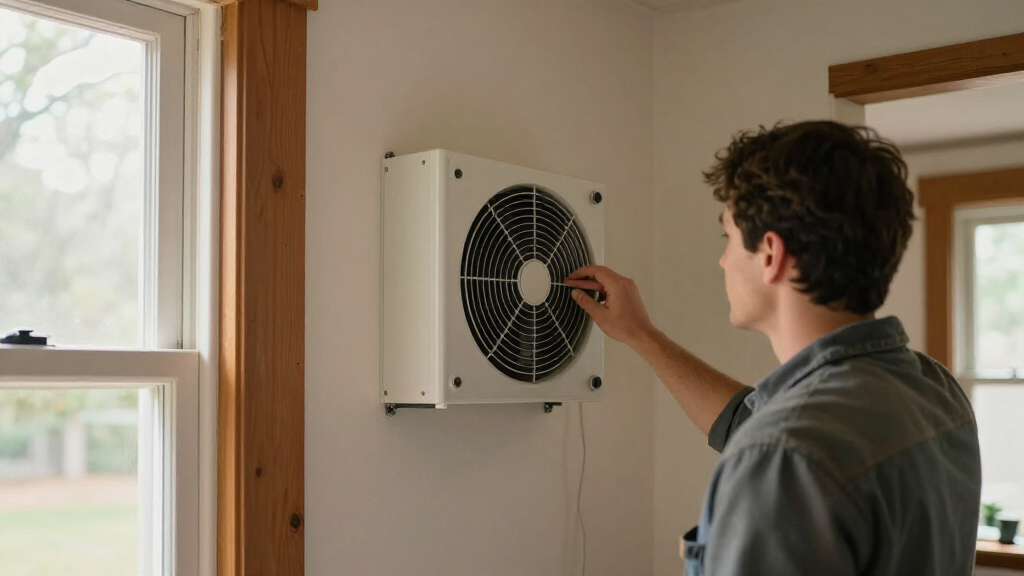
I compared these six products on the factors that shape a real through-wall ventilation decision: stated airflow and intended coverage, whether each is designed for a single room or broader home use, installation format, controls, and the heat- or energy-recovery approach described by the product. I gave more weight to a clear match between the product’s stated role and a buyer’s likely room or home than to add-on controls alone. I also treated limited published detail as a reason for caution rather than assuming that similar names or form factors mean equal performance.
The ranking favors purpose-built through-wall and single-room options for this category. The TwinFresh Expert RA1-50-2 leads as a focused ductless single-room pick; the Micra 100 and TwinFresh Comfo RB1-50-2 follow for buyers whose installation or control needs differ. The Aprilaire’s higher stated airflow may suit a larger ventilation plan, but its whole-home positioning makes it less directly comparable to compact through-wall units. The four-inch models offer a narrower, simpler form factor, yet the available details leave more questions about capacity and system fit.
| through wall heat recovery fan | Control | Installation |
|---|---|---|
| LINGGONGAIR 4 Inch Ceramic Cor | Remote control | Through the wall |
| Aprilaire V22BEC Energy Recove | Touch interface with dual fan speed control | — |
| TwinFresh Comfo RB1-50-2 Ductl | Remote control | — |
| VENTS-US Micra 100 | WiFi app and touch | Through-the-wall, wall-mounted |
| 4-Inch Heat Recovery Ventilato | WiFi app and remote control | — |
| VENTS-US Twinfresh Expert RA1- | — | Through the wall |
Factors to Consider When Choosing Through Wall Heat Recovery Fans
Before choosing a model, I would work backward from the room and installation rather than starting with controls or a product label. These fans can differ in coverage, airflow strategy, and how much wall or electrical work they require, so a small specification mismatch can leave a room under-ventilated or lead to an unnecessarily elaborate setup.
Match Airflow to the Space, Not Just the Product Name
Start with the room’s size, occupancy, and ventilation needs, then compare those needs with the manufacturer’s airflow guidance. A stated CFM figure is useful, but it does not alone tell you how well a unit will serve a particular layout or how quietly it will do so. Avoid assuming that a 120 CFM whole-home ERV is automatically a better choice for one bedroom than a lower-flow single-room ventilator. Check whether the specified airflow is continuous, selectable, or tied to a particular operating mode. When a product page does not state room coverage or operating details clearly, confirm them with the manufacturer before buying.
Decide Between Single-Room and Whole-Home Ventilation
A through-wall unit can be a practical answer for one problem room, but it may not replace a ventilation plan for the rest of the house. Single-room products such as ductless ventilators keep the installation more localized, while a whole-home-positioned ERV is aimed at a broader strategy. A common mistake is buying a larger-capacity system without accounting for ducting, controls, and how air will move between rooms. If only one room needs fresh-air exchange, a room-focused unit may be simpler to match. If several areas need ventilation, compare the complete installation rather than treating one large airflow number as the deciding factor.
Check the Wall Opening and Installation Conditions First
Measure the available wall space and confirm wall thickness, exterior clearance, and any restrictions around wiring or structure before settling on a model. A four-inch product may appear easier to fit, but its smaller opening does not guarantee compatibility with every wall assembly. Core diameter, sleeve length, exterior hood placement, and access for sealing can affect the finished installation. Buyers sometimes focus on the interior grille and overlook the outside termination, where weather exposure and clearance matter. If cutting an exterior wall is unfamiliar, include professional installation in the decision rather than treating it as an afterthought.
Understand Reversible Operation and Recovery Claims
Heat-recovery products can use different operating patterns, including reversible airflow through a ceramic core or other energy-recovery arrangements. That distinction affects how the unit exchanges indoor and outdoor air, so compare the operating cycle and manufacturer instructions rather than assuming all heat-recovery fans work alike. Recovery performance is not the same as heating the room, and no small ventilator should be treated as a substitute for a heating system. Ask how the fan behaves in cold weather and whether its operating modes match the room’s ventilation needs. Clear technical documentation matters more than broad claims in a product title.
Choose Controls You Will Actually Use
Remote controls, WiFi, and selectable modes can make daily operation easier, especially when the fan is mounted high or needs frequent adjustment. They add less value if the unit will run on a simple schedule and the controls are difficult to integrate with the household routine. Confirm what the control operates: speed, direction, timing, or multiple units can mean very different levels of convenience. Do not assume that WiFi implies app scheduling, smart-home compatibility, or dependable remote access unless those functions are documented. A straightforward control scheme may be preferable for a first-time buyer who wants fewer setup steps.
Plan for Noise, Filters, and Ongoing Access
A fan’s published airflow does not reveal how noticeable it will be at the speed you use most, so look for sound data at relevant operating settings. Also check whether filters or washable parts are included, how often the maker recommends cleaning, and whether those parts can be reached without removing the unit. A harder-to-access installation can turn routine maintenance into a task that gets postponed. Exterior grilles and air passages may also need periodic inspection, especially where dust or weather exposure is an issue. Comparing maintenance access before purchase can matter more over time than an extra control feature.
Frequently Asked Questions
Can one through-wall heat recovery fan ventilate my whole home?
Usually, a single-room through-wall fan is intended to serve the space where it is installed, not every room in a home. Air may move between rooms, but closed doors and the layout can limit that exchange. The Aprilaire V22BEC is positioned as a broader home ERV and has a stated 120 CFM capacity, so it belongs in a different planning category from the single-room options. Check the manufacturer’s coverage guidance and consider whether a whole-home system needs ducts or other equipment. For multiple rooms, compare a full ventilation plan rather than relying on one wall unit to cover the house.
Is a higher CFM rating always the better choice?
No: airflow needs depend on the room, how many people use it, and the ventilation strategy. A larger rating can be useful for a broader system, but it may be a poor fit for a small room or an installation designed around a compact single-room unit. Compare the rating with the manufacturer’s recommended coverage and operating modes, not with another product’s number alone. Noise at the setting you expect to use can also affect whether you will run the fan regularly. If coverage data is missing, ask the manufacturer before choosing based only on CFM.
Do I need an electrician or installer for a through-wall unit?
That depends on the model, the wiring arrangement, and your experience with exterior wall work. Cutting a wall opening, sealing the sleeve, fitting an outdoor hood, and handling electrical connections can involve separate skills and local code requirements. A small four-inch form factor does not automatically make installation straightforward. Review the installation manual and confirm whether the product requires hardwiring, a dedicated circuit, or specific wall thickness. If any part of the work is outside your skill set, get an installer’s assessment before ordering.
Should I choose a reversible ceramic-core fan or an ERV?
Choose based on the ventilation job and the product’s documented design, not on the terms alone. A reversible ceramic-core ventilator typically describes a localized airflow cycle, while an ERV may be intended for a broader system and energy exchange approach. The lineup includes both compact reversible-style options and the whole-home-positioned Aprilaire V22BEC, so they are not direct substitutes. Compare installation needs, airflow, recovery details, and the areas you need to serve. If humidity transfer or whole-home operation matters, confirm the manufacturer’s specifications for the exact model.
Is WiFi worth prioritizing over higher airflow or simpler installation?
WiFi is useful when remote adjustment or documented app-based scheduling fits how you plan to run the fan, but it does not improve ventilation capacity by itself. The four-inch WiFi-and-remote model may appeal to buyers who value connected controls, while the TwinFresh Comfo RB1-50-2 offers a remote-control option without the same WiFi emphasis in its name. First confirm that the unit’s airflow and installation fit the room. Then check which functions the app actually supports and whether setup depends on a stable network. If you will rarely change settings, simpler controls may be the more practical choice.
Conclusion
For most buyers seeking a dedicated single-room option, I recommend the VENTS-US TwinFresh Expert RA1-50-2 as the best overall fit in this lineup. The 4-Inch Heat Recovery Ventilator with WiFi & Remote Control is my best value-style choice for shoppers drawn to a compact format and connected controls, though I would verify its airflow and installation specifications before purchase. Beginners may prefer the TwinFresh Comfo RB1-50-2 if a remote control and clear 30 CFM rating suit their room, while buyers planning broader home ventilation should look closely at the Aprilaire V22BEC. Choose the VENTS-US Micra 100 when its FreshBox single-room system approach fits the planned installation, and consider the LINGGONGAIR 4 Inch when a compact reversible ceramic-core design is the main priority. The best match depends on your room coverage and wall setup; I would confirm those details before deciding between control features and headline airflow.
Halloween Picks
halloween
As an affiliate, we earn on qualifying purchases.