
Solar backup power stations pair a battery with solar panels so you can keep essentials running during an outage or off the grid, and the biggest tradeoff in this category is capacity versus portability versus price. For most buyers, the EF ECOFLOW DELTA 3 MAX stands out as the best overall pick, combining a 2048Wh capacity, high inverter output, and fast recharging in one package. If budget matters more than runtime, the GRECELL 519Wh covers basic emergency loads at a fraction of the cost, while the Jackery Solar Generator 1000 V2 strikes a strong middle ground for camping and home use alike. The main decisions you’ll face are how much wattage you actually need, whether LiFePO4 chemistry is worth the premium, and whether bundled panels are enough to recharge in a reasonable time. Read on for the full breakdown of all 14 options.

Get backup power and energy gear delivered free with Prime
- Fast, free delivery on millions of items
- Prime Video, Amazon Music and more included
- Member-only deals all year
Complete the kit


Key Takeaways
- Bundled solar panel wattage rarely matches battery size — several 2000Wh-class stations ship with only 200W of panels, meaning a full solar recharge can take most of a sunny day; the Jackery Explorer 2000 v2 is the only 2000Wh-class pick here that includes 400W of panels.
- LiFePO4 battery chemistry (BLUETTI AC180, ALLWEI 256Wh, and the 1024Wh 1000W unit) rated for thousands of cycles is the clear longevity winner over older NMC cells in the smaller Jackery and GRECELL units.
- Inverter output is the most common bottleneck in this lineup — budget 300W-class units can run lights and phones but will shut down on a refrigerator, while 1500W+ models like the DELTA 3 MAX and Jackery 1000 V2 handle kitchen appliances comfortably.
- Sub-300Wh stations (Jackery Explorer 300, ALLWEI 256Wh, 300W solar generator) make sense only as grab-and-go kits; per watt-hour they cost more than mid-size options, so buying them for home backup is a false economy.
- Units sold without panels (Jackery Explorer 1000 v2 standalone, Anker SOLIX C1000 Gen 2, BLUETTI AC180) offer flexibility to size your own solar array, which often works out better than default 200W bundles for buyers in cloudy regions.
| OUKITEL P2001 Pro 3200W/2048Wh Portable Power Station with 200W Solar Panel |  | Best Whole-Home Backup | Capacity: 2048Wh | Continuous Output: 3200W | Surge/Starting Wattage: 6400W | VIEW LATEST PRICE | See Our Full Breakdown |
| EF ECOFLOW DELTA 3 MAX Portable Power Station with 220W Solar Panel, 2048Wh |  | Best Overall | Capacity: 2048Wh | Running Output: 3400W | Recharge Speed: 0-80% in about 1 hour | VIEW LATEST PRICE | See Our Full Breakdown |
| GRECELL Portable Power Station 500W, 519Wh Solar Generator Backup Lithium Battery Pack |  | Best Value Mid-Size | Capacity: 519Wh | AC Output: 2 x 110V pure sine wave, 500W total | USB-C PD: 60W | VIEW LATEST PRICE | See Our Full Breakdown |
| Portable Solar Generator 300W with 60W Solar Panel | 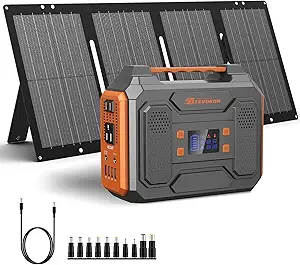 | Best Starter Kit | Power Output: 300W max | AC Outlets: 2 x 300W | Solar Panel: 60W foldable monocrystalline | VIEW LATEST PRICE | See Our Full Breakdown |
| Jackery Solar Generator 300 and 40W Solar Panel, 292Wh, 300W AC |  | Best Ultralight Pick | Capacity: 292Wh | Weight: 7.5 lbs | AC Output: 300W, 2 outlets | VIEW LATEST PRICE | See Our Full Breakdown |
| Jackery Solar Generator 1000 V2 with 200W Solar Panel |  | Best Solar Kit for Camping | Capacity: 1070Wh | AC Output: 1500W (3000W surge) | Battery Type: LFP | VIEW LATEST PRICE | See Our Full Breakdown |
| Jackery Explorer 1000 v2 Portable Power Station |  | Best Fast-Charging Value | Capacity: 1070Wh | AC Output: 1500W (3000W surge) | Battery Type: LFP | VIEW LATEST PRICE | See Our Full Breakdown |
| BLUETTI Portable Power Station AC180 |  | Best for Home Emergency Backup | Battery Capacity: 1152Wh | Battery Type: LiFePO4 | AC Output: 1800W continuous, 2700W peak | VIEW LATEST PRICE | See Our Full Breakdown |
| 1000W Portable Power Station 1024Wh LiFePO4 |  | Best Budget Starter Station | Capacity: 1024Wh | Power Output: 1000W | Battery Type: LiFePO4 | VIEW LATEST PRICE | See Our Full Breakdown |
| Jackery Explorer 2000 v2 with 2x200W Solar Panels |  | Best Whole-Home Backup Pick | Capacity: 2042Wh | AC Output: 2200W | Battery Type: LiFePO4 | VIEW LATEST PRICE | See Our Full Breakdown |
| Jackery Explorer 300 Portable Power Station, 292Wh |  | Best Ultralight Pick | Capacity: 292Wh | Output Wattage: 300W (600W surge) | Battery Type: LiFePO4, 4,000+ cycles | VIEW LATEST PRICE | See Our Full Breakdown |
| Anker SOLIX S2000 Portable Power Station, 2010Wh, 1500W |  | Best for Home Backup Longevity | Capacity: 2010Wh | Continuous Power: 1500W (3000W peak) | Battery Type: LFP, 10,000 cycles | VIEW LATEST PRICE | See Our Full Breakdown |
| ALLWEI Portable Power Station 300W, 256Wh Solar Generator LiFePO4 Battery |  | Best Budget Starter Unit | Capacity: 256Wh | Continuous Power: 300W (600W surge) | Battery Type: LiFePO4, 3,000 cycles | VIEW LATEST PRICE | See Our Full Breakdown |
| Anker SOLIX C1000 Gen 2 Portable Power Station |  | Best Speed-to-Power Balance | Capacity: 1,024Wh | Continuous Power: 2,000W (3,000W peak) | Wall Recharge: 49 minutes | VIEW LATEST PRICE | See Our Full Breakdown |
| solar backup power station | Capacity | Weight | Battery Type |
|---|---|---|---|
| OUKITEL P2001 Pro 3200W/2048Wh | 2048Wh | 50 lbs | — |
| EF ECOFLOW DELTA 3 MAX Portabl | 2048Wh | — | — |
| GRECELL Portable Power Station | 519Wh | — | — |
| Portable Solar Generator 300W | — | — | — |
| Jackery Solar Generator 300 an | 292Wh | 7.5 lbs | — |
| Jackery Solar Generator 1000 V | 1070Wh | 23.8 lbs | LFP |
| Jackery Explorer 1000 v2 Porta | 1070Wh | 23.8 lbs | LFP |
| BLUETTI Portable Power Station | — | — | LiFePO4 |
| 1000W Portable Power Station 1 | 1024Wh | 27.73 lbs | LiFePO4 |
| Jackery Explorer 2000 v2 with | 2042Wh | 66.8 lbs | LiFePO4 |
| Jackery Explorer 300 Portable | 292Wh | 7.5 lbs | LiFePO4, 4,000+ cycles |
| Anker SOLIX S2000 Portable Pow | 2010Wh | 35.7 lbs | LFP, 10,000 cycles |
| ALLWEI Portable Power Station | 256Wh | 6.4 lbs | LiFePO4, 3,000 cycles |
| Anker SOLIX C1000 Gen 2 Portab | 1,024Wh | 25 lbs (11.3 kg) | — |
More Details on Our Top Picks
OUKITEL P2001 Pro 3200W/2048Wh Portable Power Station with 200W Solar Panel
Most power stations in this roundup are camping gear that doubles as emergency power — the OUKITEL P2001 Pro flips that priority. With 3200W of continuous output and a 2048Wh battery, it can run refrigerators, space heaters, and power tools simultaneously, something mid-size options like the BLUETTI AC180 simply can’t match on raw wattage. The standout feature is its UPS mode: plug it between the wall and a critical device, and it switches over instantly during an outage, which matters if you’re protecting a medical device or a home office server.
The tradeoffs are real, though. At 50 pounds and roughly 16 inches deep, this is a unit you park in a closet, not one you haul to a campsite — the Jackery Explorer 300 wins that fight by a mile. The included 200W panel is a nice bundle, but a single panel means slow full recharges.
Pros:- 2048Wh capacity with 3200W output runs multiple large appliances at once
- UPS pass-through mode keeps critical devices powered during outages without interruption
- Bundle includes a 200W solar panel, so you’re ready for off-grid recharging out of the box
- Five outlets plus 6400W surge handling covers starting loads from motors and compressors
Cons:- At 50 pounds and 16 inches deep, it’s effectively stationary once placed
- A single 200W panel takes a long time to fully recharge a battery this large
- Higher price tier than the mid-capacity competition in this guide
Best for: Homeowners who want true outage protection for refrigerators and high-draw appliances without installing a gas generator
Not ideal for: Campers and van lifers — at 50 pounds with a bulky footprint, portability is clearly an afterthought
- Capacity:2048Wh
- Continuous Output:3200W
- Surge/Starting Wattage:6400W
- Total Outlets:5
- Solar Panel Included:200W
- Weight:50 lbs
- Dimensions:16″L x 11.3″W x 12.9″H
- Special Feature:UPS uninterruptible power mode
Our verdict“This pick makes the most sense for buyers whose first priority is riding out power outages at home rather than off-grid adventure.”
EF ECOFLOW DELTA 3 MAX Portable Power Station with 220W Solar Panel, 2048Wh
If I had to point one buyer at a single do-it-all pick, the EcoFlow DELTA 3 Max earns the top slot on the strength of one number: 0-80% recharge in just over an hour. Every competitor here with similar capacity recharges in a fraction of that speed — the OUKITEL P2001 Pro matches its 2048Wh capacity but can’t compete on turnaround time, which matters when sunlight windows are short or you’re topping up between uses. With 3400W of running power, it handles the same heavy appliances as the OUKITEL while staying easier to move.
The compromises keep it from being a clean sweep. Only three outlets means large setups with many small devices will need a power strip, and the price sits at the premium end of this guide. Compared with the Anker SOLIX S2000, you trade some outlet count for dramatically faster charging — a trade most buyers should take.
Pros:- 0-80% recharge in roughly an hour, far faster than any comparable option here
- 3400W running output handles high-demand appliances and sensitive electronics alike
- Smart app control lets you monitor and manage energy use remotely
- Five-year warranty signals long-haul build confidence
Cons:- Only three total outlets, which limits how many devices you can plug in directly
- Premium pricing places it among the most expensive picks in this guide
- Still heavy enough that ‘portable’ is generous for anything beyond car camping
Best for: Buyers who want whole-home-grade capacity with the fastest recharge cycle in this lineup
Not ideal for: Households running many small devices at once — three outlets fills up quickly without a strip
- Capacity:2048Wh
- Running Output:3400W
- Recharge Speed:0-80% in about 1 hour
- Total Outlets:3
- Solar Panel Included:220W
- Dimensions:19.5″L x 9.4″W x 12″H
- Warranty:5 years
Our verdict“This is the pick for the buyer who wants one station that does emergency backup and off-grid trips equally well and recharges fast enough to never be caught empty.”
GRECELL Portable Power Station 500W, 519Wh Solar Generator Backup Lithium Battery Pack
Between the big 2000Wh beasts and the tiny weekend units sits the GRECELL 519Wh, and it occupies that middle ground efficiently. You get enough capacity to run a laptop, phones, lights, and a small appliance through an evening outage, plus a 60W USB-C port and wireless charging pad that larger units like the Jackery Explorer 1000 v2 don’t always include at this tier. Compared with the smaller ALLWEI 256Wh, you roughly double your runtime for a modest bump in cost, which is why this is my value call.
The catch is the ceiling: 500W of output means no hair dryers, microwaves, or power tools, and unlike the OUKITEL P2001 Pro bundle, no solar panel is included — you’ll need to budget for one to actually use it as a solar generator. Recharge times of 6-9 hours by solar also demand patience.
Pros:- 519Wh capacity comfortably covers phones, laptops, lights, and CPAP machines through extended outages
- Pure sine wave AC output is safe for sensitive electronics
- Unusually versatile port selection for the price, including 60W USB-C PD and a wireless charging pad
- Three recharge paths — solar, wall, and car — add flexibility on the road
Cons:- No solar panel in the box, so solar charging requires an extra purchase
- 500W output ceiling excludes most kitchen and heating appliances
- Full solar recharges can take the better part of a day in weak light
Best for: Budget-conscious buyers who need reliable phone, laptop, and small-appliance backup without paying for capacity they won’t use
Not ideal for: Anyone planning to run heating, cooking, or cooling appliances — the 500W limit rules them all out
- Capacity:519Wh
- AC Output:2 x 110V pure sine wave, 500W total
- USB-C PD:60W
- USB-A:3 x QC3.0, 18W max
- Wireless Charging:10W
- DC/Car Ports:2 x 12V/5A, 1 x 12V/10A
- Recharge Time:6-9 hrs solar / 6-7 hrs wall / 7-8 hrs car
Our verdict“This model is better suited to buyers who want dependable small-device backup at a mid-tier price than anyone chasing whole-house capability.”
Portable Solar Generator 300W with 60W Solar Panel
For a true entry point, this 300W generator with a bundled 60W folding panel is the cheapest way to own a complete solar setup from day one — something the GRECELL 519Wh, which ships panel-less, cannot claim. Everything needed to start harvesting sunlight arrives in the box, including car and wall adapters, and the 20.5% conversion efficiency of the monocrystalline panel is respectable rather than bargain-bin. The SOS flashlight and built-in cooling round out a package clearly aimed at first-time buyers testing whether solar backup fits their life.
The limits show up quickly, though. A 300W ceiling restricts you to phones, tablets, laptops, and very small appliances — the Jackery Explorer 300 lives in the same class but offers a slicker build and stronger battery chemistry. And a practical warning: the panel’s junction box isn’t waterproof, so rain exposure is a genuine risk rather than a footnote.
Pros:- Complete kit includes the 60W folding solar panel, AC adapter, and car charging cables
- Monocrystalline panel with 20.5% conversion efficiency extracts real power from limited sunlight
- Multiple input options mean you’re never stranded if solar conditions fail
- BMS protection and active cooling protect both the battery and connected devices
Cons:- 300W output ceiling only supports small devices and appliances
- Solar panel junction box is not waterproof, limiting safe outdoor deployment
- Capacity and output are quickly outgrown once needs expand beyond basics
Best for: First-time solar buyers and casual campers who want a complete panel-plus-station kit without researching components separately
Not ideal for: Anyone backing up more than small electronics — and users who’ll leave panels outdoors in weather, given the unsealed junction box
- Power Output:300W max
- AC Outlets:2 x 300W
- Solar Panel:60W foldable monocrystalline
- Solar Efficiency:20.5%
- USB Ports:3 x 5V/3A, 1 x QC 5V/3A / 9V/2A
- DC Port:9V-12.6V, 10A max
- Safety:BMS with cooling system
- Included:AC adapter, car cable, solar panel kit
Our verdict“This option stands out for curious beginners who want the full solar experience in one affordable box and accept small-device limits in exchange.”
Jackery Solar Generator 300 and 40W Solar Panel, 292Wh, 300W AC
At 7.5 pounds, this Jackery Explorer 300 bundle is the lightest full solar setup in the roundup by a wide margin — the GRECELL 519Wh offers nearly double the capacity but at a weight and size that rule out tossing it in a backpack. That portability is the entire pitch: kayak trips, summit hikes, and emergency kits in a car trunk are exactly what this unit was built for. The LiFePO4 chemistry rated for over 4,000 charge cycles also means years of weekend use, where older battery tech would degrade noticeably.
What you give up is capacity. 292Wh runs a phone many times over but barely scratches a laptop-heavy workday, and the bundled 40W panel charges slowly — plan on most of a sunny day for a full refill. Compared with the 300W starter kit, you get lighter gear and better battery longevity but less charging throughput.
Pros:- At 7.5 lbs, it’s genuinely backpack-portable unlike every larger pick here
- LiFePO4 battery rated for 4,000+ cycles will outlast most rival chemistries in daily use
- 100W USB-C PD charges modern laptops at nearly full speed
- Diverse outlet mix (AC, USB-C, USB-A, car port) covers nearly every small device
Cons:- 292Wh capacity limits you to small electronics and short durations
- The 40W bundled panel means multi-day recharges for a full battery
- 300W output ceiling blocks anything with a heating element
Best for: Backpackers, paddlers, and car-campers who prioritize carrying weight above all else and only need device charging
Not ideal for: Anyone expecting laptop-plus-appliance backup — 292Wh and 300W cap this firmly at phone-and-tablet duty
- Capacity:292Wh
- Weight:7.5 lbs
- AC Output:300W, 2 outlets
- USB-C PD:100W
- USB-A:2 ports
- Car Port:120W
- Solar Panel Included:40W
- Battery Cycles:4,000+ (LiFePO4)
Our verdict“This pick makes the most sense for weight-conscious adventurers who want durable, cycle-tested power for devices rather than appliances.”
Jackery Solar Generator 1000 V2 with 200W Solar Panel
Unlike the standalone Jackery Explorer 1000 v2, this bundle ships with a matching 200W panel, so buyers get a complete solar generator kit rather than piecing together components. That matters here: pairing third-party panels with Jackery units can be finicky, and this kit sidesteps the guesswork. The 1070Wh LFP battery handles a mini fridge overnight plus phones, lights, and a laptop, and the 4000+ cycle rating means years of weekend trips before noticeable degradation. A full solar recharge takes roughly six hours in good conditions — slower than the BLUETTI AC180’s 500W solar input, so off-grid speed demons may want more panel wattage. The foldable handle and 23.8 lb weight make it genuinely car-camping friendly. Note that the panel and station can arrive in separate boxes, so check both tracking numbers.
Pros:- Complete kit with matched 200W solar panel included
- 4000+ cycle LFP battery built for years of regular use
- Lightweight at 23.8 lbs with a foldable carry handle
- 100W USB-C PD charging for laptops without an adapter
Cons:- Full solar recharge takes around 6 hours in good sun
- Fast charging requires initial app setup
- Panel and station may arrive in separate shipments
Best for: Campers and road-trippers who want a matched panel-plus-station kit out of one purchase
Not ideal for: Buyers needing fast off-grid recharges — 200W of solar input lags behind higher-wattage competitors
- Capacity:1070Wh
- AC Output:1500W (3000W surge)
- Battery Type:LFP
- Charge Cycles:4000+
- Weight:23.8 lbs
- Charging Time:1 hour fast charge; 6 hours via solar panel
- Ports:2 USB-C, 1 USB-A, 1 DC car port, 3 AC
Our verdict“This pick makes the most sense for campers who want a ready-to-go solar kit without researching compatible panels.”
Jackery Explorer 1000 v2 Portable Power Station
Strip away the panel from the Solar Generator 1000 V2 bundle and you get the same core unit at a lower entry point — a smart play for buyers who already own panels or plan to add them later. The headline feature is the 0-to-100% wall recharge in about an hour, which is genuinely useful for outage prep: top it off the moment power returns and it’s ready again before the next flicker. Compared with the 1024Wh generic competitor in this lineup, the Explorer offers a more polished app ecosystem and faster AC charging, though solar input is locked to Jackery’s own panels — a real limitation if you’ve invested in other brands. The LFP chemistry with a 10-year lifespan gives it staying power beyond typical NMC units.
Pros:- Full AC recharge in roughly one hour
- 4000-cycle LFP battery rated for 10+ years of use
- 1500W output with 3000W surge handles most small appliances
- Multiple port types including USB-C, USB-A, DC, and AC
Cons:- Solar charging limited to Jackery-branded panels
- Panel sold separately, unlike the bundled Solar Generator kit
Best for: Home-backup buyers who want fast wall recharging and already own or will buy Jackery panels
Not ideal for: Owners of third-party solar panels — compatibility is restricted to Jackery’s ecosystem
- Capacity:1070Wh
- AC Output:1500W (3000W surge)
- Battery Type:LFP
- Charge Cycles:4000
- Weight:23.8 lbs
- Charging Time:1 hour fast charge
Our verdict“This model is better suited to buyers prioritizing rapid wall recharges who don’t mind staying inside the Jackery panel ecosystem.”
BLUETTI Portable Power Station AC180
Where the Jackery Explorer 1000 v2 leans toward portability, the BLUETTI AC180 leans toward raw capability. Its 1800W continuous output — boostable to 2700W through the app — means it can run a microwave or hair dryer alongside basics, something the Jackery units at 1500W can’t comfortably do. With 500W of solar input, it also recharges from panels nearly twice as fast as the Jackery bundle, making it the stronger choice for extended outages where wall power stays off. Eight outlets reduce the dongle clutter that smaller units create. The tradeoff is weight and refinement: it’s heavier than comparable 1000Wh-class units, and the capacity ceiling of 1152Wh means multi-day fridge runtime is out of reach. For short outages and UPS-style switchover for home essentials, though, it’s hard to beat.
Pros:- 1800W output with app-boostable 2700W mode for demanding appliances
- 500W solar input for fast off-grid recharging
- UPS function automatically covers home essentials
- Eight outlets for simultaneous device charging
Cons:- Noticeably heavier than rivals in the same capacity class
- 1152Wh capacity limits multi-day high-draw runtime
Best for: Households wanting high-wattage backup with UPS switchover for essentials during short outages
Not ideal for: Backpackers or anyone hauling gear on foot — the weight makes it a basecamp-only unit
- Battery Capacity:1152Wh
- Battery Type:LiFePO4
- AC Output:1800W continuous, 2700W peak
- Charging Time:1 hour (AC); 2.8–3.3 hours (solar)
- Solar Input:500W
- Outlets:8
Our verdict“This option stands out for outage-prone homes that need serious wattage and solar throughput more than portability.”
1000W Portable Power Station 1024Wh LiFePO4
For buyers testing the waters before committing to a premium name, this unit covers the fundamentals: a 1024Wh LiFePO4 battery, 1000W of output, and solar compatibility for less than the big brands charge. The realistic use case is outage essentials — router, lights, a mini fridge, phones — and it handles that job capably across its 3000+ cycles. Compared with the Jackery Explorer 1000 v2, you give up app polish and faster AC charging, and the 300W solar input ceiling means a full solar recharge takes 6–8 hours with a 200W panel, versus roughly 6 for the Jackery bundle in stronger sun. At 27.73 lbs with no wheels, moving it around the house is a two-hand affair. Still, as a first power station for occasional emergencies, the compromises are reasonable ones.
Pros:- LiFePO4 chemistry with 3000+ cycles at an accessible price point
- Multiple fast-charging ports for simultaneous device use
- Works with standard solar panels up to 300W input
- Non-slip handle and manageable footprint for home storage
Cons:- 300W solar input cap slows off-grid recharging
- 27.73 lbs with no wheels makes relocation awkward
- Basic feature set compared to app-connected rivals
Best for: First-time buyers who want entry-level blackout coverage for routers, lights, and a mini fridge without paying brand premiums
Not ideal for: Off-grid users in cloudy regions — the 300W solar cap makes full recharges slow
- Capacity:1024Wh
- Power Output:1000W
- Battery Type:LiFePO4
- Cycle Life:3000+ cycles
- Weight:27.73 lbs
- Solar Input:Up to 300W
- Charging Time with 200W Panel:6–8 hours
- Color Options:Gray, Blue, Yellow
Our verdict“A sensible entry point for emergency-prep newcomers who value battery chemistry over smart features.”
Jackery Explorer 2000 v2 with 2x200W Solar Panels
This is the heavyweight of the batch. With 2042Wh of capacity and 2200W of output, the Explorer 2000 v2 sits in a different class than the 1000-series units — it can run a full-size refrigerator for a day or more, keep a CPAP and medical devices alive through a long outage, and even back up a small business register. The two bundled 200W panels give it genuine off-grid staying power, and the UPS-style switchover keeps sensitive electronics running through blips. Against the EF ECOFLOW DELTA 3 MAX at a similar 2048Wh, the Jackery counters with its LFP chemistry and compact dimensions, though EcoFlow loyalists may prefer that platform’s app depth. The honest cost is portability: at 66.8 lbs, this lives on one floor of your house. Budget it as an investment, not an impulse.
Pros:- 2042Wh capacity covers refrigeration and multiple appliances through extended outages
- 2200W output runs high-draw devices the 1000-series can’t
- Two 200W solar panels included in the bundle
- UPS switchover protects computers and sensitive gear
Cons:- 66.8 lbs makes it effectively a stationary unit
- Premium pricing puts it out of casual-buyer territory
Best for: Families and small-business owners who need multi-appliance outage coverage and can leave the unit stationary
Not ideal for: Campers who move camp daily — at nearly 67 lbs, portability is a compromise
- Capacity:2042Wh
- AC Output:2200W
- Battery Type:LiFePO4
- Solar Panels:2x 200W included
- Weight:66.8 lbs
- Dimensions:13.2″L x 10.4″W x 11.5″H
- Outlets:3 AC outlets
- Features:UPS power supply, fast charging, Cell-to-Body technology
Our verdict“Worth the spend for households treating backup power as infrastructure rather than a camping accessory.”
Jackery Explorer 300 Portable Power Station, 292Wh
At 7.5 lbs, the Explorer 300 is the lightest serious power station in this roundup, and that alone defines its role. While the ALLWEI 300W offers slightly less capacity at a similar output, the Explorer 300 counters with 4,000+ rated charge cycles from its LiFePO4 cells — a longevity claim few compact units in this class can match. The USB-C charging input means you can top it up from a laptop charger or wall adapter without a proprietary brick, which matters if your gear bag is already full. Compared with the 1,000Wh-plus units elsewhere in this guide, the tradeoff is obvious: 292Wh keeps phones, headlamps, and a drone battery alive for a weekend, but it will not run a fridge. Solar panel sold separately, which pushes the true cost of a complete kit higher.
Pros:- Featherweight 7.5 lb build that fits in a backpack side pocket
- LiFePO4 chemistry rated for over 4,000 cycles for years of use
- Charges via USB-C, wall, car, or solar for maximum flexibility
- Six output ports including two AC outlets for a unit this size
Cons:- 300W output ceiling rules out kettles, hair dryers, and most power tools
- No solar panel included, so off-grid capability costs extra
Best for: Backpackers, day-trip campers, and drone photographers who count every ounce and only need to keep small electronics alive
Not ideal for: Anyone preparing for home power outages — 292Wh can’t meaningfully run a refrigerator or medical device
- Capacity:292Wh
- Output Wattage:300W (600W surge)
- Battery Type:LiFePO4, 4,000+ cycles
- Weight:7.5 lbs
- Charge Time:4 hours
- Outlets:2 AC, 1 USB-C, 2 USB-A, 1 car port
Our verdict“Buy this if portability is your top priority and your power needs stop at laptops, cameras, and phones.”
Anker SOLIX S2000 Portable Power Station, 2010Wh, 1500W
This option stands out for one number: 10,000 charge cycles — a rating that could stretch to 15 years of regular use and comfortably outlasts the ~3,000-cycle cells in the ALLWEI 300W. With 2,010Wh of capacity, it sits in the same class as the EF ECOFLOW DELTA 3 MAX and Jackery Explorer 2000 v2, but packs it into a smaller and lighter chassis at 35.7 lbs. That capacity keeps a refrigerator, router, and lights running through most outage scenarios. The tradeoff is 1,500W of continuous output: unlike the Anker SOLIX C1000 Gen 2’s 2,000W ceiling, this unit may balk at a microwave running alongside other loads, and the absence of a 12V DC port is an annoyance for anyone with car-style accessories. The solar panel is also extra.
Pros:- 10,000-cycle LFP battery with a 15-year usable lifespan
- 2,010Wh capacity in a relatively compact 35.7 lb frame
- Up to 400W solar input for reasonably fast off-grid recharging
- Enough output for refrigerators, CPAP machines, and most home essentials
Cons:- 1,500W continuous limit can’t handle high-wattage appliances like some rivals
- No 12V DC car-style output port
- Solar panel not included despite the home-backup positioning
Best for: Homeowners in outage-prone areas who want set-and-forget emergency capacity they won’t need to replace for a decade or more
Not ideal for: Van lifers or anyone running power-hungry 12V accessories — the missing DC port and 1500W ceiling are real limits
- Capacity:2010Wh
- Continuous Power:1500W (3000W peak)
- Battery Type:LFP, 10,000 cycles
- Solar Input:Up to 400W
- Weight:35.7 lbs
- Dimensions:8.2 x 11.1 x 12.7 inches
Our verdict“The pick for buyers who care more about decade-long battery durability and total capacity than raw wattage.”
ALLWEI Portable Power Station 300W, 256Wh Solar Generator LiFePO4 Battery
For a first dip into solar backup, the ALLWEI 300W gets the fundamentals right without asking much. At 6.4 lbs it undercuts even the Jackery Explorer 300 on weight, and its pure sine wave output means sensitive electronics like laptops run cleanly — not a given at this price tier. Where it slips against the Explorer 300 is cycle life: 3,000 rated cycles versus Jackery’s 4,000+, a gap that matters if you’ll drain it weekly. The real strength is charging flexibility — dual AC-plus-solar recharging lets you refill from the wall and sun simultaneously, something the Jackery 300 doesn’t offer. With six devices powered at once, it handles a family’s small-electronics needs on a campout, but anyone eyeing the GRECELL 519Wh should note that 256Wh halves your runtime ceiling.
Pros:- Pure sine wave inverter that’s safe for laptops and sensitive gear
- Dual AC + solar recharging speeds up refills
- Lightest unit in this roundup at 6.4 lbs
- USB-C PD 60W output for fast modern device charging
Cons:- 3,000-cycle battery rating falls short of pricier rivals
- 300W ceiling limits it to small electronics and lights
- Solar panel must be purchased separately
Best for: First-time buyers and casual campers who want to try solar backup cheaply before committing to a bigger unit
Not ideal for: Extended off-grid trips or emergency prep — 256Wh runs out fast when shared across devices
- Capacity:256Wh
- Continuous Power:300W (600W surge)
- Battery Type:LiFePO4, 3,000 cycles
- Weight:6.4 lbs
- AC Charge Time:3.5–4 hours
- Solar Charge Time:4–5 hours with 100W panel
Our verdict“A sensible low-risk entry point for small loads, provided you accept its short runtime and modest battery lifespan.”
Anker SOLIX C1000 Gen 2 Portable Power Station
The C1000 Gen 2 stakes its claim on recharge speed: a full refill from the wall in 49 minutes, and solar top-ups in about 1.8 hours — numbers neither the SOLIX S2000 nor the similarly-sized Jackery Explorer 1000 v2 can touch. Pair that with a 2,000W continuous output on a 1,024Wh battery and you get a unit that punches well above its weight class, running a microwave or power tools that would trip the S2000’s 1,500W limit. The catch is straightforward: half the capacity of the 2kWh units means roughly half the runtime per charge, and at 25 lbs it’s no daypack companion — that’s Jackery Explorer 300 territory. For buyers who value quick turnaround over marathon endurance, this model makes the most sense.
Pros:- HyperFlash wall recharge in just 49 minutes
- 2,000W continuous output (3,000W peak) handles power-hungry appliances
- Solar recharge in roughly 1.8 hours for fast off-grid cycling
- Nine output ports across AC, USB-A, and USB-C
Cons:- 25 lb weight makes it awkward for frequent carrying
- Half the runtime of competing 2kWh stations like the SOLIX S2000
- Premium pricing puts it out of budget-buyer range
Best for: Campers, remote workers, and tiny-home dwellers who need high-wattage output and hate waiting on recharges
Not ideal for: Buyers prioritizing multi-day blackout endurance — the 1,024Wh capacity drains about twice as fast as 2kWh rivals
- Capacity:1,024Wh
- Continuous Power:2,000W (3,000W peak)
- Wall Recharge:49 minutes
- Solar Recharge:1.8 hours
- Weight:25 lbs (11.3 kg)
- Output Ports:9
Our verdict“The right choice when fast recharging and high wattage matter more than maximum capacity.”
How We Picked
I evaluated each of these solar backup power stations against four criteria that directly affect real-world use: usable capacity versus realistic load (how long the battery actually runs a fridge, CPAP, or laptop), inverter output and surge handling (whether it starts motor-driven appliances or trips offline), battery chemistry and cycle life (LiFePO4 units were weighted higher for longevity), and solar recharge speed based on the included or compatible panel wattage. Panel pairing mattered as much as the station itself — a large battery with an undersized panel is a poor backup solution.
Ranking also reflected fit for purpose rather than raw specs alone. A 256Wh unit scored well if it excelled as a portable kit, even though it would rank poorly as home backup. I penalized models with inflated marketing claims, weak surge ratings relative to their class, and bundles where the included panel could not reasonably recharge the battery within a day of good sun. The final order places versatile mid-to-large stations with fast solar input at the top, value-oriented mid-size units in the middle, and compact kits at the bottom of the home-backup hierarchy while still noting where those small units genuinely shine.
| solar backup power station | Battery Type |
|---|---|
| OUKITEL P2001 Pro 3200W/2048Wh | — |
| EF ECOFLOW DELTA 3 MAX Portabl | — |
| GRECELL Portable Power Station | — |
| Portable Solar Generator 300W | — |
| Jackery Solar Generator 300 an | — |
| Jackery Solar Generator 1000 V | LFP |
| Jackery Explorer 1000 v2 Porta | LFP |
| BLUETTI Portable Power Station | LiFePO4 |
| 1000W Portable Power Station 1 | LiFePO4 |
| Jackery Explorer 2000 v2 with | LiFePO4 |
| Jackery Explorer 300 Portable | LiFePO4, 4,000+ cycles |
| Anker SOLIX S2000 Portable Pow | LFP, 10,000 cycles |
| ALLWEI Portable Power Station | LiFePO4, 3,000 cycles |
| Anker SOLIX C1000 Gen 2 Portab | — |
Factors to Consider When Choosing Solar Backup Power Stations
Before choosing a solar backup power station, it helps to understand where buyers most often go wrong. These are the factors that separate a purchase you’ll rely on from one that sits in a closet.Size Your Battery to Real Loads, Not Marketing Math
The most common mistake is buying capacity based on headline watt-hours without translating it to your actual devices. A 1000Wh station runs a 100W load for roughly ten hours, but a refrigerator cycling on and off might drain it in eight to fifteen hours depending on efficiency, and a microwave alone can pull 1000W. Write down the essentials you genuinely need during an outage — usually a fridge, phone charging, a few lights, and maybe a medical device — and add 20% headroom. Buyers who skip this step either overspend on 2000Wh they never use or discover mid-outage that their 300W-class unit cannot start their fridge compressor at all.
Inverter Wattage Is the Gatekeeper
Capacity tells you how long you can run things; inverter output determines whether you can run them at all. Motor-driven appliances like refrigerators, well pumps, and furnaces need two to three times their running wattage at startup, which is where surge ratings matter. A 500W unit will run a box fan and laptops but fail instantly on a fridge; a 1500W-2000W inverter covers nearly every household essential simultaneously. Also check the AC outlet count and whether any outlet is limited below the inverter’s total rating, which is a frequent frustration on budget models.
Battery Chemistry and Cycle Life
LiFePO4 batteries typically last 3000+ charge cycles before degrading to 80% capacity, while older lithium-ion chemistries in some compact units are rated closer to 500-800 cycles. For occasional camping use, that difference barely matters. For a station you plan to keep for a decade of outages and regular use, chemistry is arguably the single biggest value factor — a cheaper NMC unit replaced twice costs more than one LiFePO4 unit kept. LiFePO4 is also more thermally stable, which matters if the station lives in a garage or vehicle in hot climates.
Solar Input and Panel Pairing
Check the station’s maximum solar input wattage, not just what panel comes in the box. A 2048Wh battery limited to 200W of input needs over ten hours of ideal sun for a full recharge — a real problem during multi-day outages in winter. Look for models accepting 400W or more of input so you can add panels later, and verify connector compatibility before buying third-party panels. Also note that a 200W panel rarely produces 200W in practice; expect 60-80% of rated output in typical conditions and plan your recharge math accordingly.
Bundled Kit Versus Buying Separately
Bundles look convenient, but the included panel is often the weakest part of the package. Buying the station alone and pairing it with higher-wattage panels frequently costs a similar amount and halves your recharge time. On the other hand, bundles guarantee compatibility and usually include the right cables and charge controller integration, which matters if you’re new to solar. My general rule: first-time buyers benefit from bundles; anyone who has already run the numbers should buy the station and panels separately.
Weight, Portability, and Storage Reality
A 2000Wh station weighs 40-60 pounds — fine for a shelf in the garage, impractical for hauling to a campsite. Think honestly about whether you’ll move the unit regularly or station it permanently for home backup, because paying for portability you don’t use is wasted budget, and struggling with a heavy unit means it stays where you don’t need it. Also consider where it will be stored: batteries degrade faster in extreme heat and cold, and you’ll want the unit near where you’ll use it since running long extension cords wastes capacity and creates trip hazards.
Frequently Asked Questions
Can a solar backup power station actually run my refrigerator during an outage?
Yes, but only if you check two numbers first. Your fridge’s compressor needs a surge of roughly 1200-1500W at startup, so the station’s inverter and surge rating must exceed that — the 300W and 500W units in this lineup cannot do it, while 1500W+ models like the Jackery 1000 V2 and BLUETTI AC180 handle it easily. Runtime depends on capacity and your fridge’s efficiency: expect 8-20 hours from a 1000Wh station and double that from a 2000Wh-class unit. Keep the panel connected during daylight and you can stretch that indefinitely in good weather, which is exactly the scenario where pairing a big battery with adequate solar input pays off.
Is a bigger battery always the better buy?
No, and oversizing is one of the most common wasted expenses. If your real outage needs are phones, lights, a router, and a fan, a 500Wh unit covers a full day comfortably and a 2000Wh station is dead weight — literally, since large units weigh 40-60 pounds. Larger batteries also cost far more per useful hour if you never tap the extra capacity. That said, capacity becomes the right call if you want fridge runtime, live in an area with multi-day outages, or plan to add solar for quasi-off-grid use. Match the size to a written list of your actual loads rather than the biggest number you can afford.
Do I need LiFePO4, or is standard lithium fine?
It depends on how often you’ll cycle the battery. If the station lives in a closet for occasional outages and a couple of camping trips per year, a standard lithium-ion unit rated for 500-800 cycles will likely outlast your interest in it. If you use it weekly — van life, frequent off-grid work, or daily solar cycling — LiFePO4’s 3000+ cycle rating means it will still hold most of its capacity a decade from now while the cheaper chemistry degrades in two to three years. LiFePO4 also tolerates heat better and is less prone to thermal issues, a meaningful factor for anything stored in a vehicle or hot garage.
How long does it take to recharge one of these with solar panels?
Divide the battery capacity by your panels’ real-world output — typically 60-80% of the rated wattage in decent sun. A 2048Wh battery with a 200W panel realistically needs 13-17 hours of good sunlight, meaning more than one full day in practice, which is why I flagged undersized bundles throughout this roundup. Doubling to 400W of panels cuts that to a single sunny day. In cloudy or winter conditions, expect output to drop by half or more, so anyone relying on solar through storms should buy a station with high solar input limits and extra panels rather than trusting the bundle in the box.
Can I keep a power station plugged in at home so it’s ready for an outage?
Most modern units support pass-through or standby charging, letting them sit plugged in and topped up — but check the manual, because a few budget models recommend against continuous charging. Keeping it at full charge continuously can slightly accelerate battery aging on some chemistries; several brands now hold the battery around 80-90% until needed, which is gentler. Store it in a temperature-stable spot, run a full discharge-and-recharge cycle every few months to keep the battery meter accurate, and confirm the unit is placed where you can reach it easily, since an outage is the worst time to discover it’s buried behind boxes in the garage.
Conclusion
The right pick depends entirely on what you’re backing up. For best overall, the EF ECOFLOW DELTA 3 MAX delivers the best balance of capacity, inverter muscle, and recharge speed in this lineup. For best value, the GRECELL 519Wh covers genuine emergency basics without overspending, while the Jackery Solar Generator 1000 V2 is the smarter value if you need fridge-capable output. For best premium, the Jackery Explorer 2000 v2 with 400W of panels is the only kit here sized to actually recharge its own big battery in a day. For beginners, the Jackery Explorer 300 kit is a low-risk way to learn solar basics before committing to a large system, and the BLUETTI AC180 suits buyers who want to size their own panel array. Whatever you choose, size the battery to a written list of your real loads — that single step prevents more regretted purchases than any spec comparison in this guide.
Fall Picks
fall essentials
As an affiliate, we earn on qualifying purchases.