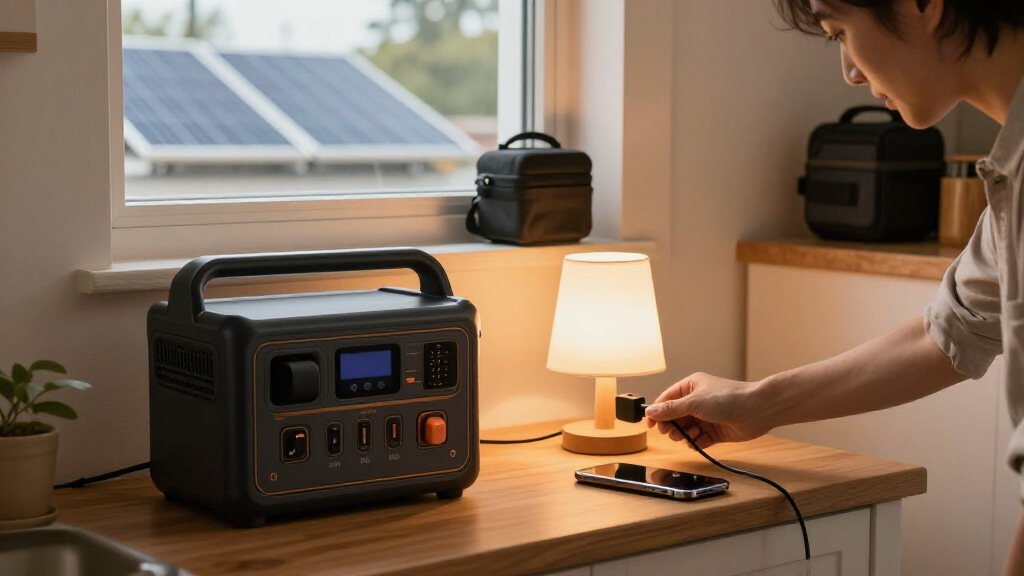

This checklist is for homeowners, campers, and anyone comparing portable backup power options for outages or off-grid use. The picks span battery stations, solar charging, expanded storage, generator backup, a transfer switch, and a portable heater, so you can focus on the parts that match your setup.

Get backup power and energy gear delivered free with Prime
- Fast, free delivery on millions of items
- Prime Video, Amazon Music and more included
- Member-only deals all year
The sections are organized by equipment role, not as a one-size-fits-all system. A power station stores electricity, a folding panel can provide a charging option, and generator-related equipment serves a different backup approach. The heater is a separate source of warmth, not a battery-powered appliance.
Use each section to check capacity, output, compatibility, and installation needs against what you actually plan to run. Confirm product specifications and connection requirements before buying, especially when combining equipment. For hardwired home backup or fuel-burning appliances, follow the manufacturer’s directions and consult a qualified professional where appropriate.
Portable Power Station
A portable power station is the core storage component in a battery-based backup setup. The Jackery HomePower 3600 Plus is listed with 3,584Wh capacity and 3,600W AC output, giving you two figures to compare with your intended loads: stored energy and the output available to connected devices. Make a list of essential appliances, note their power requirements, and consider which ones may run at the same time. A listed output figure alone does not establish runtime; actual use depends on the connected equipment and operating conditions.
A common mistake is choosing by capacity alone or assuming every appliance can connect directly. Check the station’s ports, output limits, and any requirements for sensitive or high-demand equipment. Verify that its form factor and charging options suit where you plan to use and store it, and leave room for cables and ventilation as directed by the manufacturer. If you expect to add solar charging or other components, confirm input and connection compatibility before purchase rather than assuming products will work together.
What to look for:
- Compare 3,584Wh capacity with the energy needs of your planned loads.
- Check the 3,600W AC output against the appliances you may run simultaneously.
- Review available ports and charging inputs for your intended setup.
- Confirm compatibility with any solar panels or accessories you plan to use.
- Check placement, storage, and manufacturer ventilation guidance.
Jackery HomePower 3600 Plus Power Station, 3584Wh, 3600W AC Output

The Jackery HomePower 3600 Plus provides up to 3600 W of continuous power (7200 W in parallel) and a 3584 Wh battery that can be expanded to 21 kWh per unit or 43 kWh with multiple units, enough to run a typical three‑person household for over two weeks. It features fast hybrid charging—full charge in 2 hours via AC+DC—and supports AC, solar, and generator inputs.
Pros:
- High continuous power output with expandable capacity for whole‑home backup.
- Fast hybrid AC+DC charging can fully recharge the unit in just 2 hours.
- Durable LFP battery provides long cycle life and operates across a wide temperature range.
- Portable luggage‑style design includes wheels and telescopic handle for easy transport.
Cons:
- Despite being lighter than competitors, the unit is still relatively heavy to move frequently.
- Solar charging is slower, taking up to 4 hours for a full charge.
Best for: Households seeking a portable battery station with substantial listed capacity and AC output.
Not ideal for: Buyers who have not checked appliance loads, ports, or charging compatibility.
Bottom line: Match its stated capacity and output to your actual loads, then verify connections before building around it.
Folding Solar Panel
A folding solar panel can provide a portable charging option for a compatible power station, making it a useful category to consider when you want to recharge away from a fixed outlet. The Renogy 400W Portable Foldable Solar Panel identifies its rated power and foldable design in the product name. Before buying, check the power station’s solar-input specifications and the panel’s connector and electrical details; a matching wattage label does not by itself confirm compatibility.
Think about where and how you will use the panel. Folding models need space to unfold and a suitable place to position them, and your setup should account for cable reach and the directions supplied by the manufacturer. A frequent mistake is treating the stated panel rating as a guarantee of what it will deliver in every situation. Check the product documentation for operating requirements, included connections, and care instructions, then consider whether portability and setup fit your routine. Keep the panel’s storage dimensions and handling needs in mind if you expect to transport it regularly.
What to look for:
- Confirm the panel’s electrical specifications match the power station’s solar input.
- Check connector type and whether any additional connection components are needed.
- Consider unfolded working space, cable reach, and a stable placement area.
- Review the folded size and handling requirements for transport and storage.
- Read manufacturer guidance on setup, operation, and care.
Renogy 400W Portable Foldable Solar Panel

This 400W portable solar panel features high-efficiency A+ monocrystalline cells with 23% efficiency and durable ETFE coating for long-term use. It folds down to a compact size with a carry case, offering 1-minute setup with rust-proof kickstands and IP67 waterproofing for RVs, camping, and off-grid power.
Pros:
- High 23% efficiency with A+ monocrystalline cells
- Compact and lightweight design with included carry case
- Fast 1-minute setup with no tools required
- Durable construction with IP67 waterproofing and hail resistance
Cons:
- Relatively heavy at 30.2 lbs compared to smaller panels
- Requires a separate portable power station or battery to store energy
Best for: Users looking for a portable solar panel to pair with a compatible power station.
Not ideal for: Buyers who have not verified solar-input and connector compatibility.
Bottom line: Check the station’s solar-input limits and connection details before choosing a panel.
Power Station Expansion Battery
An expansion battery is intended to add stored energy within a compatible power system, so the first question is system compatibility, not the capacity headline. The listed Anker SOLIX F3800 Portable Power Station and Expansion Battery name includes 7,680W, but that figure should not be treated as a direct measure of stored energy. Check the manufacturer’s specifications to distinguish output ratings from capacity and to understand exactly which components are included in the configuration.
Before selecting an expansion setup, confirm the connection method, supported combinations, and any limits on how the battery can be used with the station. A common buying mistake is assuming an expansion battery will work with another brand or model, or that adding storage changes the system’s output capability. Check where the connected equipment will sit, how you will access its controls and connections, and what the manufacturer says about operation and storage. Compare the system’s documented capacity and output ratings with your essential-load plan, rather than relying on a single number in a product name.
What to look for:
- Verify the expansion battery is supported by the exact power station model.
- Clarify which components are included in the listed configuration.
- Check documented storage capacity separately from output ratings.
- Review connection, expansion, and operating limits in the manufacturer’s specifications.
- Plan a suitable location and access to the system’s controls and connections.
Anker SOLIX F3800 Portable Power Station and Expansion Battery, 7,680Wh

The Anker SOLIX F3800 is a high-capacity portable power station with 3.84kWh, expandable up to 26.9kWh with additional batteries. It features dual-voltage AC outputs, supports EV charging, and can power RV appliances, making it ideal for extended off-grid use.
Pros:
- High expandable capacity suitable for extended power needs
- Supports EV charging and powering RV appliances
- Durable design with smart remote control via app
Cons:
- Separate dispatch of power station and expansion batteries may delay setup
- Complex setup for multiple units and batteries
- No specific price information available
Best for: Owners seeking additional storage within a compatible Anker SOLIX F3800 setup.
Not ideal for: Buyers who need a universal add-on or have not confirmed included components.
Bottom line: Confirm the exact system configuration and capacity details before treating this as an expansion purchase.
Dual Fuel Inverter Generator
A dual-fuel inverter generator is a separate backup-power path from a battery station, and it calls for fuel and operating planning as well as load planning. The Westinghouse iGen12000DFc is identified as a dual-fuel portable inverter generator. Before choosing it, review the manufacturer’s specifications for supported fuels, output, connections, and operation. Determine which appliances you intend to supply and whether their requirements fit the generator’s documented capabilities.
A common mistake is assuming that “dual-fuel” means any fuel can be used, or that a portable generator can connect directly to household wiring without the appropriate equipment. Follow the product’s fuel and operating instructions, and never run a fuel-burning generator indoors or in an enclosed space. Check storage and placement needs, access to the required fuel, and any local requirements that apply. If you want to power household circuits, ask a qualified professional about the proper transfer equipment and installation instead of improvising a connection.
What to look for:
- Verify supported fuel types and operating requirements in the product documentation.
- Compare documented output and connections with your planned appliances.
- Plan safe outdoor placement and follow all manufacturer safety instructions.
- Check fuel storage and handling requirements before purchase.
- Use appropriate, professionally installed transfer equipment for household circuits.
Westinghouse iGen12000DFc Dual-Fuel Portable Inverter Generator
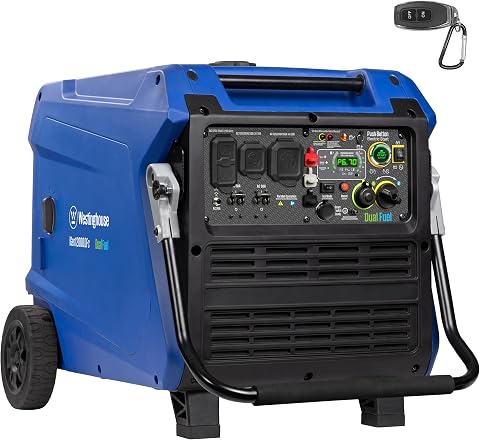
The Westinghouse iGen12000DFc is a dual-fuel inverter generator designed for home backup, with low total harmonic distortion for sensitive electronics. It offers remote and electric start, a digital data display, transfer-switch-ready outlets, and up to 19 hours of runtime at 25% load on gasoline.
Pros:
- High output for home backup and major appliances
- Dual-fuel operation with gasoline and propane
- Low THD for sensitive electronics
- Long runtime with remote start and useful display
Cons:
- Large fuel tank and high output may make the unit bulky to move
- Runtime figure applies at only 25% load
Best for: Buyers considering a portable inverter generator and planning for its fuel requirements.
Not ideal for: Anyone expecting indoor operation or an improvised home-wiring connection.
Bottom line: Review loads, fuel requirements, and safe installation needs before choosing a generator.
Generator Transfer Switch
A transfer switch is part of a planned home-backup connection, not a substitute for confirming which generator or other power source can support the circuits you want to use. The listed pick is the Generac 22kW Whole Home Generator with Transfer Switch and Cellular Ca; check the complete product listing and manufacturer documentation to clarify the exact package and what “Cellular Ca” refers to. Verify whether the equipment suits your home, electrical service, and intended backup arrangement.
One of the most important buying mistakes is treating transfer equipment as a plug-in accessory. Connecting a generator to home wiring requires equipment and installation appropriate to the system; have a qualified electrician review the setup and applicable requirements. Check which circuits or loads are covered, how the switch is configured, and what components are included. Also confirm that the named generator and transfer switch are compatible as supplied, rather than assuming that similarly named products form a complete installation. Plan for professional assessment and installation before purchase.
What to look for:
- Confirm the exact product configuration and included transfer equipment.
- Have a qualified electrician assess compatibility with your home electrical service.
- Identify the circuits and loads the planned system is intended to serve.
- Verify generator and transfer-switch compatibility in manufacturer documentation.
- Check installation, operation, and applicable local requirements before purchase.
Generac 22kW Whole Home Generator with Transfer Switch and Cellular Capability

This Generac 22kW home standby generator provides automatic whole-house backup power during outages. It includes cellular connectivity for remote monitoring and control through the Mobile Link app, along with a transfer switch for home installation.
Pros:
- Provides automatic whole-house backup power during outages
- Built-in cellular connectivity enables remote monitoring and control
- Electronic fuel and ignition control improves efficiency and lowers emissions
- Backed by a 5-year limited warranty and 24/7 customer support
Cons:
- Mobile Link remote monitoring requires a premium subscription
- Whole-home standby installation may require professional setup
- Transfer switch and outdoor placement add installation complexity
Best for: Homeowners planning professionally assessed generator backup for household circuits.
Not ideal for: Buyers seeking a simple portable add-on or a do-it-yourself wiring solution.
Bottom line: Confirm the exact package and have a qualified electrician plan the installation.
Battery-Powered Space Heater
The listed Mr. Heater Portable Buddy is a propane radiant heater, not a battery-powered space heater. Its name specifies a 4,000–9,000 BTU range and portable use, so treat it as a separate heating option rather than assuming it can draw from a portable power station. Check the manufacturer’s instructions for permitted settings, fuel requirements, placement, and operating conditions before using it.
A frequent mistake is relying on a fuel-burning heater without checking ventilation and safety directions. Follow all warnings and never use it in a way the manufacturer prohibits. Consider where it will be operated, how fuel will be handled and stored, and whether the intended space and use meet the product’s requirements. Confirm the heater is suitable for your situation and that everyone using it understands the instructions. For a backup plan, keep heat and electricity as separate equipment decisions: this product name does not indicate battery operation or power-station compatibility.
What to look for:
- Note that the listed heater is propane-powered, not battery-powered.
- Review the stated 4,000–9,000 BTU range and manufacturer operating instructions.
- Confirm permitted placement and ventilation requirements for the intended use.
- Check fuel handling and storage directions before purchase.
- Keep heater safety planning separate from power-station compatibility.
Mr. Heater Portable Buddy Radiant Propane Heater, 4,000–9,000 BTU

This portable radiant propane heater offers low and high heat settings for indoor or outdoor use, with coverage of up to approximately 225 square feet. It connects to a 1 lb propane cylinder or, with compatible accessories, a 20 lb tank, and includes an oxygen depletion sensor, thermal shutoff, and tip-over switch.
Pros:
- Portable design for indoor and outdoor use
- Two heat settings with output up to 9,000 BTU/hr
- Built-in oxygen, thermal, and tip-over safety systems
Cons:
- Requires propane and compatible accessories for use with a 20 lb tank
- Run time on a 1 lb cylinder is limited
Best for: People seeking a portable radiant propane heater and able to follow its operating instructions.
Not ideal for: Buyers specifically looking for a battery-powered heater or power-station accessory.
Bottom line: Treat this as a propane heater, and follow the manufacturer’s safety and use directions.
Start with the essentials: list the loads or heating needs you want to cover, then check the relevant product specifications and compatibility. Prioritize a power station or generator only after matching its documented output and connections to your plan; consider a solar panel or expansion battery only once you have verified the charging and system requirements. For household wiring, put professional assessment first, and budget time for safe planning, fuel handling, and proper installation where relevant.
You do not need to buy every category at once. Build a setup around the jobs you actually need it to do, confirm the details that affect fit and safety, and add compatible equipment only when it solves a clear need. A little careful checking can make your backup-power choices more practical and help you avoid mismatched components.
Fall Picks
fall essentials
As an affiliate, we earn on qualifying purchases.