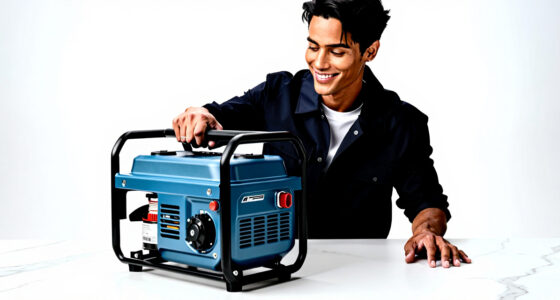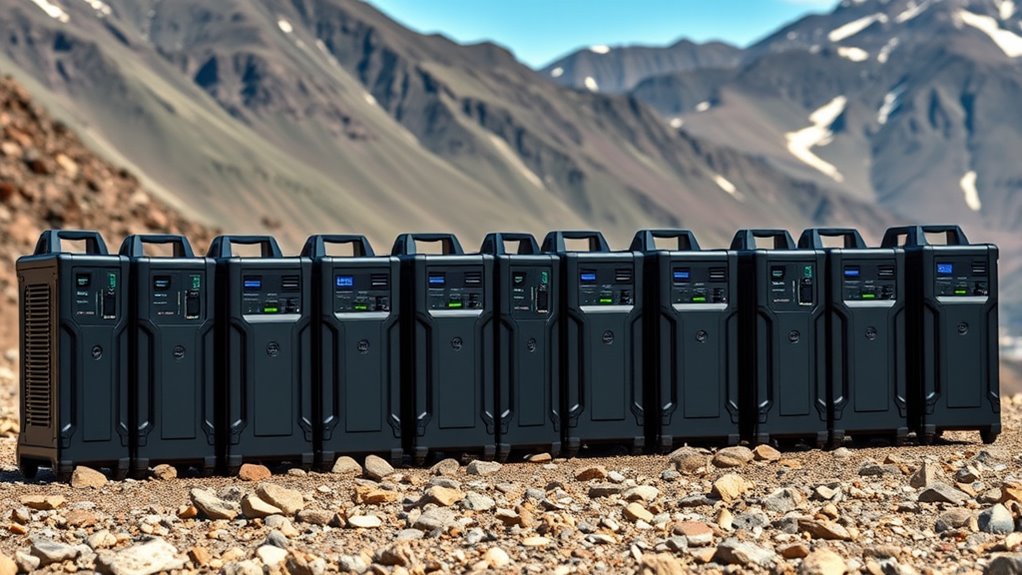

When I compare portable power stations around 5000Wh that can expand, the key choice is whether you need whole-home-class output, a lower-cost entry into a large battery system, or a simpler 120V setup. The Jackery Explorer 5000 Plus is my strongest all-around fit for high-demand backup because it combines 5040Wh, 7200W output, dual voltage, and expansion up to 60kWh. Its renewed version offers similar headline capability, but its short warranty makes the condition tradeoff impossible to ignore. The P5000 Plus provides the largest stated starting capacity and weighs less, though its 3600W output and 1000W solar input set a lower ceiling for heavy loads and rapid solar replenishment.

Get backup power and energy gear delivered free with Prime
- Fast, free delivery on millions of items
- Prime Video, Amazon Music and more included
- Member-only deals all year
I rank these options by usable system potential, not capacity alone. A large battery can run equipment for longer, but output determines which appliances it can start and run at once; expansion plans, recharge speed, weight, and warranty shape the rest of the decision. I also distinguish verified product details from assumptions: the P5000 Plus description does not state whether its capacity is expandable, so I would not treat that model as a confirmed expandable system without checking the seller’s current documentation.
Complete the kit


Key Takeaways
- Best match for expandable home backup: The new Jackery Explorer 5000 Plus pairs 5040Wh with 7200W output and stated expansion to 60kWh.
- Do not confuse battery capacity with appliance support: The P5000 Plus has 5120Wh, but its 3600W continuous output is half the Jackery’s stated 7200W.
- Renewed Jackery needs a warranty-minded buyer: It retains dual voltage and 60kWh expansion, but the listed 90-day limited warranty is far shorter than the new model’s five years.
- Portability is relative at this capacity: The P5000 Plus is the lightest listed unit at 112 pounds; it is still a heavy appliance to move often.
- Confirm expansion before buying the P5000 Plus: Its supplied details describe a 5120Wh battery but do not establish compatible add-on batteries or a maximum expanded capacity.
| Jackery Explorer 5000 Plus Portable Power Station |  | Best Overall for Expandable Home Backup | Battery capacity: 5040Wh | Battery type: LiFePO4 | AC output: 7200W; 14,400W surge | VIEW ON AMAZON | See Our Full Breakdown |
| Jackery Explorer 5000 Plus Portable Power Station (Renewed) |  | Best for Buyers Seeking the Same Expandable Platform in Renewed Condition | Battery capacity: 5000Wh | Battery type: LiFePO4 | AC output: 7200W; 14,400W maximum | VIEW ON AMAZON | See Our Full Breakdown |
| P5000 Plus 5120Wh Portable Power Station, 3600W Solar Generator |  | Best for a Large Starting Battery and Lower Carry Weight | Battery capacity: 5120Wh | Battery type: LiFePO4 | Continuous output: 3600W | VIEW ON AMAZON | See Our Full Breakdown |
| portable power stations 5000wh expandable | Battery capacity | Battery type | Output voltage | Weight |
|---|---|---|---|---|
| Jackery Explorer 5000 Plus Por | 5040Wh | LiFePO4 | 120V / 240V | 134.5 lbs |
| Jackery Explorer 5000 Plus Por | 5000Wh | LiFePO4 | 120V / 240V | 132 lbs |
| P5000 Plus 5120Wh Portable Pow | 5120Wh | LiFePO4 | 120V | 112 lbs |
More Details on Our Top Picks
Jackery Explorer 5000 Plus Portable Power Station
The new Jackery Explorer 5000 Plus is my first choice when “expandable” means building beyond a single large battery. Its stated 5040Wh capacity starts at the scale this roundup targets, while its 60kWh expansion ceiling gives a buyer a path from emergency coverage toward longer home-backup periods. The 7200W AC output and 120V/240V support also give it a broader appliance role than the P5000 Plus, whose continuous output is 3600W and whose listed voltage is 120V. That distinction can matter more than the small capacity difference between the units when a household has high-demand equipment.
Charging flexibility helps this model fit backup planning: the supplied details list up to 4000W solar input and solar recharging in about two hours under the stated conditions. That is a more substantial solar-input figure than the P5000 Plus’s 1000W maximum, though panel availability and real-world sunlight affect the outcome. Its LiFePO4 battery and five-year warranty add a stronger ownership case than the renewed Jackery’s 90-day limited warranty. I would still check the exact expansion accessories and electrical setup required for the intended installation rather than assuming a single unit can connect to every home circuit.
The tradeoff is physical: at 134.5 pounds, this is a stationary backup unit with handles, not a station I would plan to move casually between campsites. Solar panels are sold separately, adding setup decisions and extra equipment. Compared with the lighter P5000 Plus, the Jackery gives up 22.5 pounds for substantially higher stated output, dual voltage, and documented expansion. For buyers who need those system capabilities, that is a meaningful exchange; for occasional low-load use, it may be more equipment than necessary.
Pros:- 5040Wh LiFePO4 battery with stated expansion up to 60kWh.
- 7200W AC output and 120V/240V support suit demanding backup applications.
- Up to 4000W solar input supports a larger solar-recharge setup.
- Five-year warranty is substantially longer than the renewed model’s listed coverage.
Cons:- At 134.5 pounds, it is difficult to move frequently.
- Solar panels are sold separately.
- Its full expansion capability may require compatible add-on equipment and planning.
Best for: Households planning expandable backup for high-demand appliances and wanting 120V/240V output, high AC power, and a five-year warranty.
Not ideal for: Buyers who need a genuinely easy-to-carry camping station, want included solar panels, or only need modest 120V loads.
- Battery capacity:5040Wh
- Battery type:LiFePO4
- AC output:7200W; 14,400W surge
- Output voltage:120V / 240V
- Expansion:Up to 60kWh
- Maximum solar input:Up to 4000W
- Weight:134.5 lbs
- Warranty:5 years
Our verdict“I rank the new Jackery first for buyers who want confirmed large-scale expansion, high output, and dual voltage in one backup platform.”
Jackery Explorer 5000 Plus Portable Power Station (Renewed)
The renewed Explorer 5000 Plus retains the core system traits that make the new Jackery my overall pick: a roughly 5000Wh LiFePO4 battery, 7200W AC output, 120V/240V support, and stated expansion up to 60kWh. It also lists 0ms UPS switching for critical electronics, plus app control and operation under 30dB. Against the P5000 Plus, it is the more capable match for larger loads and planned whole-home backup; against the new Explorer 5000 Plus, its main distinction is not a stronger power system but its renewed condition and shorter warranty.
That warranty is the central buying decision. The listed 90-day limited warranty is a much shorter safety net than the five years listed for the new model. A buyer may value the same broad power and expansion platform in renewed condition, but should inspect the seller’s condition and return terms and confirm what is covered. I would not treat “renewed” as interchangeable with new, especially for a heavy, high-capacity unit intended to be available during an outage. The UPS claim may suit people protecting sensitive devices, though its practical setup and supported outlets should be verified for the equipment involved.
At 132 pounds, it is only slightly lighter than the new unit and remains a poor fit for frequent carrying. Its quiet, zero-emission operation is useful where a fuel generator’s noise or exhaust would be unwelcome, but those qualities do not remove the need to plan charging and load priorities. I place it second because its electrical capability is compelling, yet the new Jackery’s longer listed warranty makes it the easier recommendation for buyers who want this platform for long-term backup. Choose this one only if renewed condition and the warranty terms work for your risk tolerance.
Pros:- 7200W AC output with 120V/240V support for demanding appliances.
- Stated expansion up to 60kWh.
- Listed 0ms UPS mode and smart app control support backup management.
- Quiet operation under 30dB and no generator exhaust during use.
Cons:- Renewed condition carries a listed 90-day limited warranty.
- At 132 pounds, it is not convenient to carry regularly.
- Its system capability is close to the new Explorer 5000 Plus, which has a much longer listed warranty.
Best for: A warranty-conscious but renewed-product buyer who wants dual-voltage output, UPS functionality, and a stated route to 60kWh expansion.
Not ideal for: Buyers who want new-condition equipment, long warranty coverage, frequent portability, or a lower-risk long-term backup purchase.
- Battery capacity:5000Wh
- Battery type:LiFePO4
- AC output:7200W; 14,400W maximum
- Output voltage:120V / 240V
- Expansion:Up to 60kWh
- UPS switching:0ms, as listed
- Weight:132 lbs
- Warranty:90-day limited warranty
- Condition:Renewed
Our verdict“I recommend this renewed Jackery only to buyers who accept the shorter warranty in exchange for the same broad output and expansion claims.”
P5000 Plus 5120Wh Portable Power Station, 3600W Solar Generator
The P5000 Plus has the largest stated starting capacity here at 5120Wh and is the lightest of the three at 112 pounds. Those figures make it appealing for buyers who prioritize stored energy in one unit and may need to reposition it occasionally. Its 3600W continuous output, however, is far below the Jackery models’ 7200W rating. That gives the Jackery pair an advantage when the plan includes higher-demand appliances or multiple heavy loads; the P5000 Plus fits better when the equipment stays within its output limit and long runtime matters more than maximum simultaneous power.
The charging figures also call for a clear-eyed comparison. The product description claims a full AC recharge in 2.2 hours, while the listed AC input is 1800W; it also lists a maximum solar input of 1000W, a quarter of the new Jackery’s stated maximum solar input. These numbers describe different charging routes, so I would verify the exact conditions behind the advertised AC time and not assume solar recovery will match it. Fifteen outlets, including USB-C PD, AC, DC, and a 12V-style outlet, give it a useful range for electronics and equipment. Its 120V-only output is less flexible than the Jackery models’ dual-voltage setup.
For this particular search, its biggest limitation is missing documentation: the supplied specifications do not confirm expandable capacity, compatible expansion batteries, or a maximum system size. I would not buy it on the assumption that it can grow to match the Jackery’s stated 60kWh system. The 3500-cycle LiFePO4 claim and three-year technical-support warranty give buyers useful details, but the single-unit capacity alone does not fulfill every meaning of “5000Wh expandable.” It earns a place as a large-capacity alternative, with a firm instruction to verify expansion before purchase.
Pros:- 5120Wh starting capacity is the largest listed in this group.
- 112-pound weight is lower than either Jackery model.
- Fifteen outlets include USB-C PD and several AC, USB-A, and DC options.
- LiFePO4 battery is rated for up to 3500 cycles.
Cons:- The supplied details do not confirm expansion compatibility or an expanded capacity limit.
- 3600W continuous output is substantially below the Jackery models’ 7200W.
- 1000W maximum solar input and 120V-only output restrict some backup plans.
Best for: Buyers who want a 5120Wh single-unit station, a somewhat lower listed weight, many outlet types, and loads that remain within 3600W.
Not ideal for: Anyone who requires confirmed battery expansion, 240V appliances, high combined output, or a clearly specified large-scale home-backup pathway.
- Battery capacity:5120Wh
- Battery type:LiFePO4
- Continuous output:3600W
- Surge output:5000W
- Output voltage:120V
- Maximum solar input:1000W
- Weight:112 lbs
- Outlets:15
- Warranty:3-year customer service and technical support
Our verdict“I see the P5000 Plus as a strong large-battery alternative, but not a confirmed expandable pick until its add-on battery support is verified.”

How We Picked
I focused on the promise behind this roundup: roughly 5000Wh of stored energy with a credible path to a larger system. That makes expansion support a deciding factor, not a decorative feature. I gave the clearest preference to products whose supplied specifications state an expansion ceiling, then compared their output, voltage, charging, weight, battery chemistry, and warranty. By that standard, the new Jackery ranks first because its 60kWh expansion claim sits alongside high output and 120V/240V support. The renewed Jackery ranks second: its system capability is similar, but its condition and 90-day warranty reduce buyer protection. The P5000 Plus ranks third for this specific search because its available description does not confirm expansion, despite its impressive starting capacity.
I also separated runtime capacity from power delivery. Watt-hours indicate how much energy is stored; watts indicate how much power can be supplied at a time. A 5120Wh battery may run equipment for a long stretch, yet a 3600W continuous limit can rule out some combinations of large appliances that a higher-output unit may handle. I considered solar input and AC charging as practical recovery factors, while recognizing that actual recharge time depends on input conditions and setup. Weight matters too, but none of these is a lightweight carry-around battery. I have not treated unprovided details—such as P5000 Plus expansion compatibility—as confirmed features.
Factors to Consider When Choosing Portable Power Stations 5000wh Expandable
I would choose by the whole power system I need, not by the biggest capacity number on the label. For this group, the first question is whether a confirmed expansion path matters more than starting capacity, weight, or cost of ownership. Then I would match output and voltage to the actual appliances, followed by a realistic charging plan.
Verify that expansion is real and compatible
“Expandable” should mean more than a product name or a high watt-hour figure. Check that the manufacturer identifies compatible add-on batteries, the maximum system capacity, and any cables or control components required. The two Explorer 5000 Plus listings state expansion up to 60kWh; the P5000 Plus details provided here do not state an expansion option. I would ask the seller or manufacturer for direct confirmation before treating it as expandable, especially if the aim is to grow from emergency use to several days of household coverage.
Match output to appliances, not just runtime
Capacity is stored energy; continuous wattage is the load the station can support at once. The Jackery units list 7200W AC output and 120V/240V, while the P5000 Plus lists 3600W continuous output and 120V. A larger stored battery does not compensate for an output ceiling that an appliance exceeds. Check each device’s running watts, startup demand, voltage, and whether you intend to run more than one large appliance together. Surge ratings can help with brief startup needs, but they are not the same as continuous capacity.
Plan for recharge as well as stored energy
A station’s usefulness depends on how soon it can be charged again after a long outage or off-grid day. The new Jackery lists up to 4000W solar input; the P5000 Plus lists 1000W maximum solar input and an advertised 2.2-hour full AC charge. Treat stated recharge times as conditions-dependent: input power, battery state, temperature, and charging settings affect actual results. Confirm which panels, cables, or outlets are needed and whether the available solar area can deliver enough input for your routine.
Treat weight as a setup choice
At 112 to 134.5 pounds, these are substantial units even before adding solar panels or expansion batteries. The P5000 Plus is the lightest listed, but a 112-pound station is still better suited to a planned move than frequent carrying. I would think about where the unit will sit, whether a second person or cart will be needed, and how close it can stay to the appliances or transfer equipment. For a home backup system, placement and safe cable routing matter more than the word “portable.”
Compare warranty and condition
The new Explorer 5000 Plus lists a five-year warranty, while the renewed Jackery lists a 90-day limited warranty. That gap affects how confidently I would recommend the renewed option for a system expected to support essential loads over time. The P5000 Plus lists three years of customer service and technical support, which is not necessarily identical to a product warranty. Read the actual coverage, exclusions, return window, and seller terms before deciding; do not assume support wording offers the same protection as a warranty.
Estimate runtime from the loads you will actually use
As a rough planning method, add the watts of the devices running at the same time, then estimate hours of use. A device drawing 100W for ten hours uses about 1000Wh before conversion losses and other system overhead. Actual runtime will be lower than a simple capacity division suggests and can vary with load, temperature, battery condition, and inverter efficiency. Make a priority list for an outage—such as refrigeration, communication, lights, or medical equipment—and use that list to compare a 5000Wh starting battery with a larger expandable system.
Frequently Asked Questions
Which option is the clearest choice for a 5000Wh expandable system?
I would start with the new Jackery Explorer 5000 Plus. Its listed 5040Wh capacity, 7200W output, dual 120V/240V support, and stated expansion to 60kWh align most directly with buyers seeking a large system that can grow. The renewed version lists similar expansion but carries a much shorter warranty. The P5000 Plus has a 5120Wh battery, but the supplied details do not confirm expansion.
Does a 5120Wh battery automatically mean more power than a 5040Wh battery?
No. Watt-hours describe stored energy and can help estimate runtime, while watts describe how much power the unit can deliver at one time. The P5000 Plus lists 5120Wh but 3600W continuous output; the new Jackery lists 5040Wh and 7200W AC output. A buyer running high-demand appliances may prefer the Jackery’s higher output even though its starting capacity is slightly lower.
Can the P5000 Plus be expanded with extra batteries?
The product details supplied for this comparison do not identify compatible expansion batteries or a maximum expanded capacity. I would not assume it expands based on its name or battery size. Before buying for a growing home-backup system, confirm expansion compatibility and limits in current manufacturer documentation or with the seller.
Is the renewed Jackery a good substitute for the new model?
It may suit a buyer who wants the listed 7200W output, 120V/240V support, and stated 60kWh expansion while accepting renewed condition. The listed 90-day limited warranty is much shorter than the new unit’s five-year warranty, so I would compare coverage and return terms carefully. For long-term outage planning, the new model is the safer recommendation based on the supplied warranty details.
Are these power stations portable enough for camping?
All three can be transported, but their listed weights range from 112 to 134.5 pounds, so I would not treat them as easy carry-in camping batteries. They make more sense in an RV, at a base camp, or at a job site where the unit can stay in one place. If frequent lifting is part of the plan, consider how it will be loaded, moved, and secured before choosing any of these high-capacity models.
Conclusion
For a confirmed expandable system with high output and dual voltage, I recommend the new Jackery Explorer 5000 Plus. It is the strongest fit for households planning to add capacity over time, though its weight and separately sold solar panels call for deliberate setup. Choose the renewed Jackery only if you specifically want that platform and accept its 90-day limited warranty. The P5000 Plus suits buyers who value a 5120Wh starting battery, a lower listed weight, and varied outlets, but I would verify expansion support before choosing it for an expandable-system requirement. The deciding question is not simply which battery holds the most energy: it is whether its output, expansion path, recharge options, and warranty match the loads you expect it to support.