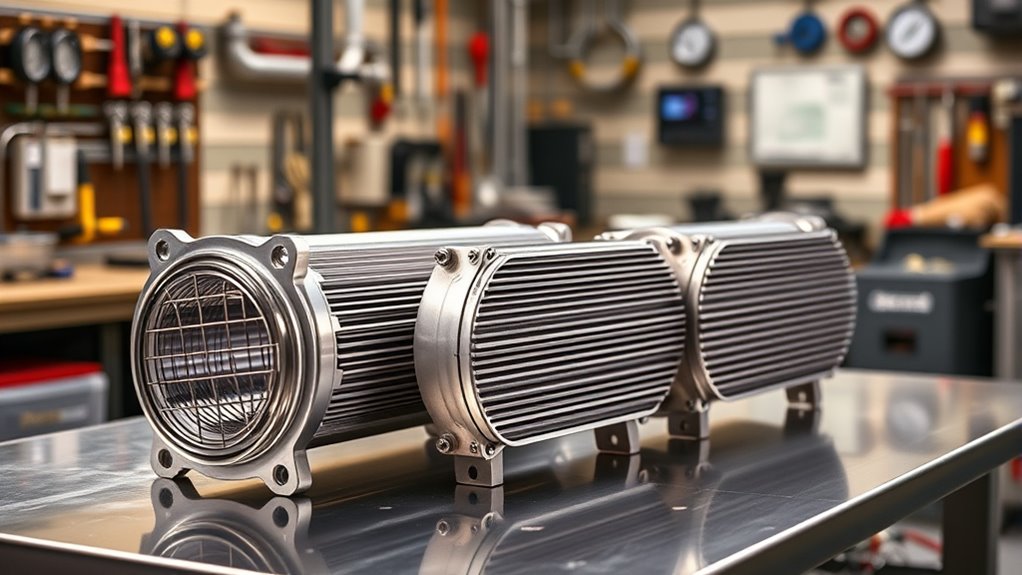

Shopping for hydronic coil heat exchangers 18×20 means checking more than the face dimensions: rated output, coil depth, port layout, airflow, and available cabinet space all shape the fit. My closest match is the 18×20 Water to Air Heat Exchanger (B07HDSCPPP), with an 18-by-20-inch finned area and a stated output of 133,086 BTU under specified test conditions. For a smaller opening, I’d compare the 18×18 model (B07HY9Z56Q); for a lower-output, lighter option, the Finned Coil Water to Air Heat Exchanger (B0HC449R9M) is the more modest choice.

Get backup power and energy gear delivered free with Prime
- Fast, free delivery on millions of items
- Prime Video, Amazon Music and more included
- Member-only deals all year
The main tradeoff is straightforward: the exact 18×20 coil offers more face area, but it still depends on hot-water temperature and airflow to approach its published output. The 18×18 units can fit tighter spaces, while the listings with less complete performance data call for extra verification. I’ve ranked these picks by how clearly they match an 18×20 buying search, the usefulness of their published specifications, and the fit tradeoffs buyers should resolve before ordering.
Key Takeaways
- B07HDSCPPP is the direct 18×20 match: its 18-by-20-inch finned area and 133,086-BTU rating are specified at 180°F water, 15 GPM, and 2,000 CFM.
- B07HY9Z56Q is the practical smaller alternative: its 18×18 finned area and 120,536-BTU capacity may suit a narrower air-handler opening.
- B071NLZSPX has a size-label mismatch: its title says 18×18, but listed dimensions are 28.94 inches wide by 23.23 inches high, so confirm the actual orientation and opening fit.
- B0HC449R9M favors simpler handling over output: at 8 pounds and 60,000 BTU, it is a different capacity class from the larger wood-furnace coils.
- B0GZN9PWLJ lists 120K BTU but is 18×18: its stated output and dimensions do not make it a direct 18×20 replacement.
| 18×20 Water to Air Heat Exchanger Hot Water Coil for Outdoor Wood Furnace |  | Best Overall — the clearest direct 18×20 match | Finned area: 18 x 20 in | Overall dimensions: 18-1/4 x 22 x 3-1/2 in | Dimensions with manifold: 18-1/4 x 25 x 3-1/2 in | VIEW ON AMAZON | See Our Full Breakdown |
| 18×18 Water to Air Heat Exchanger Hot Water Coil for Outdoor Wood Furnace |  | Best Smaller Alternative — a documented 18×18 coil | Finned area: 18 x 18 in | Overall dimensions: 18-1/4 x 20 x 3-1/2 in | Dimensions with manifold: 18-1/4 x 23 x 3-1/2 in | VIEW ON AMAZON | See Our Full Breakdown |
| Water to Air Heat Exchanger 18×18 1″ Copper Ports Hot Water Coil Outdoor Wood Furnace |  | Best for Buyers Who Can Verify Fit — strong listed capacity, ambiguous dimensions | Title size: 18 x 18 in | Listed dimensions: 28.94 W x 23.23 H x 5.31 D in | Stated capacity: 120,000 BTU | VIEW ON AMAZON | See Our Full Breakdown |
| VEVOR Water to Air Heat Exchanger, 18 x 18 in Finned Tube HVAC Coil with Copper Tubes & Aluminum Fins, 120K BTU Output |  | Best Broad-Use 18×18 Option — stated output with a compact face | Finned size: 18 x 18 in, as stated in title | Listed dimensions: 23.2 W x 3.5 H x 18.1 D in | Weight: 17.4 lb | VIEW ON AMAZON | See Our Full Breakdown |
| Finned Coil Water to Air Heat Exchanger (18×20) |  | Best Lower-Output Pick — lighter handling for modest heating loads | Size designation: 18 x 20 in | Heat output: 60,000 BTU | Weight: 8 lb | VIEW ON AMAZON | See Our Full Breakdown |
| hydronic coil heat exchangers 18×20 | Tube rows | Connections |
|---|---|---|
| 18×20 Water to Air Heat Exchan | 3 rows of 3/8-in seamless copper | 1-in copper sweat inlet and outlet |
| 18×18 Water to Air Heat Exchan | 3 | 1-in copper sweat inlet and outlet |
| Water to Air Heat Exchanger 18 | 3 rows of 3/8-in seamless copper tubes | 1-in copper ports |
| VEVOR Water to Air Heat Exchan | — | — |
| Finned Coil Water to Air Heat | — | — |
More Details on Our Top Picks
18×20 Water to Air Heat Exchanger Hot Water Coil for Outdoor Wood Furnace
This is the most straightforward choice for a buyer whose opening is designed around an 18×20-inch finned area. Its listed 133,086-BTU output includes the operating conditions behind the number: 180°F water, 15 GPM, and 2,000 CFM airflow. That makes this rating more interpretable than a headline capacity without test details, though your system must come reasonably close to those conditions to expect similar heat transfer.
The coil uses three rows of 3/8-inch seamless copper tubes, aluminum fins spaced at 12 per inch, and 1-inch copper sweat connections. Compared with the 18×18 B07HY9Z56Q, it offers a larger stated finned face and higher listed capacity, but it also asks for more cabinet space. The overall body is 18-1/4 by 22 by 3-1/2 inches; including the copper manifold, the listed length grows to 25 inches. That difference can decide whether an otherwise suitable coil fits.
A lifetime warranty against manufacturer defects adds useful coverage, but it does not remove the need to check installation requirements or confirm what the warranty covers. The unit is described as heavy and bulky, and performance remains tied to plumbing and airflow. I’d rank it first for an actual 18×20 replacement; I would not order it based only on the face measurement without checking manifold clearance and connection access.
Pros:- Finned area is explicitly listed as 18×20 inches.
- 133,086-BTU figure includes water temperature, flow, and airflow conditions.
- Three rows of seamless copper tubing with aluminum fins.
- Limited lifetime warranty against manufacturer defects is stated.
Cons:- Manifold adds length beyond the 18-1/4-by-22-inch body dimensions.
- Bulky handling and installation may call for a second person.
- Rated output depends on matching the stated system conditions.
Best for: Buyers replacing an 18×20 water-to-air coil in a forced-air system who can provide roughly the listed water flow and airflow.
Not ideal for: Anyone with a tight cabinet, lower-temperature water, limited pump capacity, or airflow far below the listing’s 2,000-CFM test condition.
- Finned area:18 x 20 in
- Overall dimensions:18-1/4 x 22 x 3-1/2 in
- Dimensions with manifold:18-1/4 x 25 x 3-1/2 in
- Tube rows:3 rows of 3/8-in seamless copper
- Connections:1-in copper sweat inlet and outlet
- Fin spacing:12 per inch
- Listed output:133,086 BTU at 180°F water, 15 GPM, and 2,000 CFM
- Warranty:Lifetime warranty against manufacturer defects, as listed
Our verdict“I’d choose this first when the installation truly calls for an 18×20 finned face and the system can support its stated operating conditions.”
18×18 Water to Air Heat Exchanger Hot Water Coil for Outdoor Wood Furnace
When an 18×20 coil will not fit, this 18×18 finned-area model is the most clearly documented step down in this group. It lists 120,536 BTU, three tube rows, 3/8-inch tubing, and 1-inch copper sweat connections. The smaller face can help with a tighter air handler, but the published description does not give the water temperature, flow, and airflow behind its capacity figure. I’d treat that number as a reference rather than a direct promise for a particular system.
Compared with the lead B07HDSCPPP, this unit gives up two inches of finned width and lists a lower output, while keeping the same basic copper-tube and aluminum-fin approach. Its body measures 18-1/4 by 20 by 3-1/2 inches, expanding to 23 inches with the manifold. That makes manifold clearance relevant here too, even though the finned area is smaller.
The listing describes lead-free construction and a limited lifetime warranty against manufacturer defects. Those details may suit a buyer tying the coil into a boiler or outdoor wood furnace, but they do not substitute for checking water chemistry, system pressure, and the warranty terms. I’d favor this over the 18×20 unit only when the smaller footprint solves a real fit problem; if the opening accepts 18×20, the larger model has a stronger documented capacity case.
Pros:- Clearly specified 18×18 finned area and overall dimensions.
- Three rows of copper tubing with aluminum fins.
- 1-inch copper sweat connections.
- Limited lifetime warranty against manufacturer defects is listed.
Cons:- Smaller face and lower stated output than the 18×20 lead pick.
- Capacity conditions are not supplied in the provided listing details.
- Manifold extends the unit to 23 inches in one dimension.
Best for: Buyers who need an 18×18 finned coil for a narrower cabinet and want copper sweat connections with a stated warranty.
Not ideal for: Those with a true 18×20 opening to fill or buyers who need capacity ratings tied to specific water and airflow conditions.
- Finned area:18 x 18 in
- Overall dimensions:18-1/4 x 20 x 3-1/2 in
- Dimensions with manifold:18-1/4 x 23 x 3-1/2 in
- Tube rows:3
- Tube diameter:3/8 in
- Connections:1-in copper sweat inlet and outlet
- Fin spacing:12 per inch
- Listed capacity:120,536 BTU
- Warranty:Limited lifetime warranty against manufacturer defects, as listed
Our verdict“I’d pick this over the 18×20 model only when the smaller face is needed to match the available cabinet space.”
Water to Air Heat Exchanger 18×18 1″ Copper Ports Hot Water Coil Outdoor Wood Furnace
This listing has a useful combination of 1-inch copper ports, copper tubing, aluminum fins, and a listed 120,000-BTU capacity. It is described for outdoor wood furnaces as well as heating, cooling, and hybrid applications. The problem for an 18×20 shopper is the size information: the title says 18×18, while the supplied dimensions are 28.94 inches wide by 23.23 inches high by 5.31 inches deep. That is a meaningful mismatch, not a detail I’d ignore.
Compared with B07HY9Z56Q, which provides an 18×18 finned area plus body and manifold dimensions, this option is harder to fit confidently from the listing alone. It states 12 aluminum fins and three rows of 3/8-inch seamless copper tubes per inch, but does not provide a comparable test condition for its capacity. The claimed maximum heat output is 360,000 BTU per hour, a much higher figure than the stated 120,000-BTU capacity; because the relationship between those figures is not explained, I would not use the maximum as a sizing basis.
The galvanized-steel housing may appeal to buyers seeking a substantial outdoor-furnace coil, but the listed weight and port orientation are not supplied. Installation also requires suitable mounting and piping. This earns a place for buyers willing to confirm dimensions directly before purchase, not for someone who needs a dependable drop-in 18×20 replacement from the product page alone.
Pros:- 1-inch copper ports are specified.
- Copper tubes, aluminum fins, and galvanized-steel housing are listed.
- Suitable applications include outdoor wood furnaces and hybrid systems.
- A 120,000-BTU capacity figure is provided.
Cons:- Title dimensions conflict with the supplied overall measurements.
- The 360,000-BTU maximum output is not explained by test conditions.
- Weight and port orientation are not specified in the provided details.
Best for: Buyers considering a wood-furnace coil who can obtain a dimensioned drawing and verify port orientation before committing.
Not ideal for: Anyone needing an unambiguous 18×20 replacement, a clearly stated face size, or capacity figures tied to operating conditions.
- Title size:18 x 18 in
- Listed dimensions:28.94 W x 23.23 H x 5.31 D in
- Stated capacity:120,000 BTU
- Maximum heat output:360,000 BTU per hour, conditions not supplied
- Tube rows:3 rows of 3/8-in seamless copper tubes
- Connections:1-in copper ports
- Materials:Galvanized steel, copper, and aluminum
- Applications:Outdoor wood furnace, heating, cooling, and hybrid systems
Our verdict“I’d consider it only after confirming the true coil dimensions and reconciling its capacity figures with the seller.”
VEVOR Water to Air Heat Exchanger, 18 x 18 in Finned Tube HVAC Coil with Copper Tubes & Aluminum Fins, 120K BTU Output
VEVOR’s coil is a compact 18×18-class alternative, not a direct 18×20 match. Its listing states 120,000 BTU per hour, copper tubes, aluminum fins, and a steel casing; it also gives a 17.4-pound weight and a maximum temperature of 356°F. Those details are useful for preliminary screening, but the listing information provided does not identify water flow, entering water temperature, or airflow for the output figure. I would not compare its 120K rating directly with B07HDSCPPP’s 133,086 BTU test result as if both came from the same conditions.
Against the other 18×18 coil, B07HY9Z56Q, VEVOR offers more temperature and weight information, while the other model gives more precise body and manifold dimensions and a stated limited lifetime warranty. VEVOR’s listed dimensions are 23.2 inches wide by 3.5 inches high and 18.1 inches deep, but those numbers do not plainly identify which measurement corresponds to the finned face. Buyers should confirm orientation and connection placement before planning a cabinet opening.
The product description mentions leak testing and epoxy-coated fins, but installation accessories are not included. At 17.4 pounds, mounting still needs to support the coil and connected plumbing. This pick makes more sense for someone comparing general HVAC coil options than for someone who needs a proven 18×20 drop-in unit.
Pros:- Lists copper tubing, aluminum fins, and steel casing.
- Provides a stated 120,000-BTU-per-hour output.
- Maximum temperature and item weight are specified.
- Description states the coil is leak-tested.
Cons:- The listed dimensions do not clearly identify the finned-face orientation.
- Output test conditions are not supplied in the provided details.
- No installation accessories are included.
Best for: Buyers seeking an 18×18 water-to-air coil for a compatible HVAC setup and able to confirm its dimensions and operating conditions.
Not ideal for: Anyone who specifically needs an 18×20 finned face, supplied installation accessories, or a capacity rating with published airflow and water-flow conditions.
- Finned size:18 x 18 in, as stated in title
- Listed dimensions:23.2 W x 3.5 H x 18.1 D in
- Weight:17.4 lb
- Heat output:120,000 BTU/h (35.2 kW stated)
- Materials:Aluminum fins, copper tubes, steel casing
- Maximum temperature:356°F
- Maximum pressure:2,500,000 pascal
- Operating range:-40°F to 356°F
Our verdict“I’d treat this as an 18×18 candidate for a verified HVAC fit, not as a substitute for a dimensionally confirmed 18×20 coil.”
Finned Coil Water to Air Heat Exchanger (18×20)
This listing offers an 18×20 label with a 60,000-BTU output and an unusually low stated weight of 8 pounds. That combination makes it the low-output, easier-handling option in this lineup, not a like-for-like alternative to the 133,086-BTU B07HDSCPPP. For a modest load or a secondary heating application, the smaller capacity may be appropriate; for a large forced-air system or a wood-furnace coil sized around higher output, the listing gives less headroom.
The construction is described as copper tubes with densely packed aluminum fins, and the coil is intended for indoor forced-air installation. Unlike the two wood-furnace coils above, the supplied details do not state tube rows, fin spacing, connection size, or physical dimensions beyond the 18×20 name. That missing information makes cabinet and plumbing checks especially important. Its 30-day return policy is not equivalent to the manufacturer-defect lifetime warranties listed for B07HDSCPPP and B07HY9Z56Q.
I’d put it ahead of the ambiguous B071NLZSPX only for buyers prioritizing lower stated output and easier handling, since its 60,000-BTU figure is clear. I would not rank it higher for an 18×20 replacement: buyers need verified dimensions, pressure limits, and port details before deciding whether it can connect safely to their system.
Pros:- 18×20 size is stated in the product title.
- Listed 60,000-BTU output gives a clear lower-capacity position.
- Eight-pound weight may make handling easier than the heavier alternatives.
- Copper tubes and aluminum fins are specified.
Cons:- No full physical dimensions or connection sizes are provided here.
- Output is far below the leading 18×20 pick’s stated capacity.
- Only a 30-day return policy is listed, with no detailed defect warranty.
Best for: Buyers with a moderate heating requirement who want a lighter indoor coil and can confirm missing fit and connection details.
Not ideal for: Those replacing a high-output wood-furnace coil or needing full dimensions, port sizing, tube-row data, and a detailed warranty.
- Size designation:18 x 20 in
- Heat output:60,000 BTU
- Weight:8 lb
- Construction:Copper tubes with aluminum fins
- Fin design:Densely packed aluminum fins
- Mounting:Inline
- Application:Indoor forced-air HVAC and hydronic heating
- Warranty or return detail:30-day return policy listed
Our verdict“I’d choose it only for a lower-output indoor application after confirming dimensions, ports, and system compatibility.”

How We Picked
I ranked these five options for someone searching specifically for an 18×20 hydronic water-to-air coil, not as interchangeable heat exchangers. The closest dimensional fit comes first, followed by smaller coils that may work where cabinet space is limited. I also weighed the quality of the available performance information: a BTU figure is more useful when the listing says what water temperature, flow, and airflow produced it.
I treated the stated dimensions and capacities as listing data, not guaranteed results in every installation. Heat transfer changes with water temperature, gallons per minute, air volume, and duct resistance; a coil cannot deliver a rating if the system conditions differ. I also looked at connection type, coil construction, weight, warranty details when supplied, and whether the product description leaves unanswered fit questions. I do not assume that an 18×18 or loosely described 18×20 model will fit an existing cabinet without measuring the coil, manifold, and clearance.
The order reflects how well each listing helps an 18×20 shopper make a decision. B07HDSCPPP earns the lead for its exact stated finned area and test conditions. B07HY9Z56Q follows as the clearest smaller-size alternative; the remaining picks have more substantial specification or size uncertainties, which lower their ranking for this particular search.
Factors to Consider When Choosing Hydronic Coil Heat Exchangers 18×20
Before choosing among these coils, I’d match the unit to the actual air-handler opening and hydronic system, rather than treating the size in a title as a complete fit specification. The differences between an 18×20 face, an 18×18 face, and the full dimensions including manifolds can determine whether installation is straightforward or impossible.
Check the full fit, not just the face size
Measure the existing opening and the available depth, then compare those numbers with the coil body and manifold dimensions. B07HDSCPPP is the clearest example: its finned area is 18×20, but its body is 18-1/4 by 22 inches and the manifold increases a dimension to 25 inches. Those are separate measurements with different consequences for cabinet fit. B07HY9Z56Q likewise grows from an 18×18 finned face to a 23-inch dimension including the manifold. Ask for a drawing if the listing does not identify dimensions or port orientation.
Read BTU claims alongside their operating conditions
A heat-output rating is useful only when you know what produced it. The lead 18×20 coil gives a rating at 180°F water, 15 GPM, and 2,000 CFM, which lets me compare the claim against a system’s design. The other listings provide less complete conditions. Output will change if the water arrives cooler, the pump moves less water, or the blower delivers less air. Do not size a coil from a headline BTU figure alone; ask a qualified HVAC or hydronic professional to check the load and operating conditions.
Match ports and plumbing to the existing loop
Connection size and type affect adapters, flow, and installation space. B07HDSCPPP and B07HY9Z56Q specify 1-inch copper sweat connections, while B071NLZSPX lists 1-inch copper ports without the same connection detail. The two other listings provide limited port information in the supplied specifications. Confirm whether your system requires sweat, threaded, or another connection, and check pressure, temperature, water chemistry, and any manufacturer requirements before connecting a coil.
Treat 18×18 models as alternatives, not exact replacements
B07HY9Z56Q and VEVOR’s B0GZN9PWLJ are identified as 18×18 options. Their smaller face may suit a restricted opening, but neither is automatically an 18×20 replacement. The VEVOR dimensions also do not plainly map each measurement to the finned face, so confirmation matters. B071NLZSPX needs particular scrutiny because its title says 18×18 while the supplied overall measurements are substantially larger. Verify the dimensional drawing before ordering any listing with inconsistent or incomplete sizing.
Weigh warranty, handling, and supplied details
The two wood-furnace listings B07HDSCPPP and B07HY9Z56Q specify limited lifetime coverage against manufacturer defects. B0HC449R9M lists a 30-day return policy, which is a different kind of protection; the VEVOR details supplied here do not state a warranty. Weight and accessories also affect installation: the 8-pound B0HC449R9M is easier to handle on paper than VEVOR’s 17.4-pound unit, while several listings warn that larger coils are bulky. Confirm what is included, how the unit must be supported, and the current written warranty terms before purchase.
Frequently Asked Questions
Which product here is the closest match to an 18×20 hydronic coil?
B07HDSCPPP is the clearest match because its finned area is explicitly listed as 18×20 inches. Its body and manifold dimensions are larger than the finned face, so I would compare the full measurements with the cabinet and connection clearance before ordering. The other products either identify as 18×18 or provide less certain sizing information.
Will an 18×18 coil work in a system designed for an 18×20 coil?
It may fit physically in some openings, but a smaller finned face can change heat-transfer capacity and airflow behavior. The 18×18 B07HY9Z56Q lists 120,536 BTU, while the 18×20 B07HDSCPPP lists 133,086 BTU under stated conditions. Those figures are not directly interchangeable unless the system conditions and required heating load are checked, so I’d confirm sizing with a qualified installer.
Why does the 18×20 coil’s BTU rating include water flow and airflow?
A water-to-air coil transfers heat from the hydronic loop into moving air, so both sides affect output. The lead model’s 133,086-BTU figure is listed at 180°F water, 15 GPM, and 2,000 CFM. Lower water temperature, reduced flow, or lower airflow can produce a different result. I’d compare those conditions with the actual boiler, pump, blower, and duct setup rather than assuming the headline capacity will be reached.
What should I verify before buying an 18×20 replacement coil?
Check the finned face, full coil-body dimensions, manifold extension, depth, port size and type, port orientation, and available service clearance. Also verify system pressure and temperature limits, water flow, blower airflow, and the coil’s required mounting support. This is especially important for B071NLZSPX, whose title and supplied overall dimensions do not align cleanly, and for listings with incomplete connection data.
Can these coils be installed in any forced-air furnace or air handler?
No. The cabinet needs enough room for the coil and its connections, and the blower must move suitable airflow across the finned area. The hydronic loop also needs compatible water temperature, flow, pressure, and plumbing. Installation may require changes to ductwork, controls, piping, or mounting, so I’d have an HVAC or hydronic professional check compatibility and safety before selecting a coil.
Conclusion
For a buyer who needs a genuine 18×20 finned face, I’d start with B07HDSCPPP because its dimensions and capacity conditions are the most useful in this comparison. If the cabinet requires an 18×18 coil, B07HY9Z56Q is the better-documented smaller alternative; VEVOR is another 18×18 candidate when its orientation and installation details are confirmed. For a modest indoor heating load and easier handling, B0HC449R9M may suit, but its 60,000-BTU output is in a different class. I’d shortlist B071NLZSPX only after resolving the size mismatch and clarifying its output figures. In every case, match the coil to the real opening, water loop, and airflow—not the title alone.
Columbus Day / Indigenous Peoples' Day Picks
long weekend sales
As an affiliate, we earn on qualifying purchases.