TL;DR
Solar backup power systems pair solar panels with a battery, inverter, and controls that disconnect your home from the grid during an outage. The right setup depends on which appliances you back up, how much power they draw at once, how long you need them, and whether the system can recharge from solar while the grid is down. Backup protection and electricity bill savings are separate benefits, and neither is guaranteed by panels alone.
A sunny rooftop can go dark during a blackout. Most grid-connected solar panels shut down when the utility grid fails unless the system has approved backup controls, and usually a battery, to keep power flowing safely.

Get backup power and energy gear delivered free with Prime
- Fast, free delivery on millions of items
- Prime Video, Amazon Music and more included
- Member-only deals all year
Solar backup power systems combine panels, a battery, an inverter, and controls that isolate your home from the grid. That equipment can keep a refrigerator humming, a router blinking, and selected lights on—or support a much larger share of your home, if it has enough capacity.
This guide explains what each component does, how to estimate runtime, and what to compare before you buy. You’ll also see why backup power and bill savings are different goals, and why an electrician or qualified installer should review your home’s wiring, local permits, and utility rules.
Grid-tied solar panels generally shut down in an outage unless approved backup controls, and typically a battery, let them operate safely.
Use kW to check how many appliances can run at once and kWh to estimate how long stored energy can last.
Estimate runtime from actual appliance loads and usable battery capacity; a 10 kWh battery at a 0.5 kW average load gives a simplified 20-hour estimate.
Essential-circuit backup can suit refrigerators, lights, internet, and selected devices; larger loads need verified inverter output and more stored energy.
Check local permits, utility rules, warranty terms, safety certifications, and current incentives with qualified professionals.
Outage protection and bill savings are separate benefits; calculate each using your household’s loads, tariff, and reserve needs.
Know What Each Part Does Before the Lights Go Out
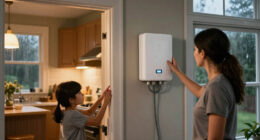
Solar backup power systems keep selected household circuits running by combining panels, a battery, an inverter, and backup controls. The controls disconnect the backed-up circuits from the utility during an outage, while the inverter turns stored or solar electricity into the form your appliances use. Panels alone usually cannot power a typical grid-connected home during a blackout.
Think of the equipment as a small water system. Panels are the source, the battery is a storage tank, the inverter is a pump with a limited flow rate, and the controller is the valve that separates your home from the street main. A large tank cannot deliver water fast enough through a narrow pipe; likewise, ample battery energy cannot overcome an undersized inverter.
For example, imagine a winter outage at a home with a refrigerator, Wi-Fi router, several lamps, and a gas furnace whose controls need electricity. A battery system wired to those circuits may keep food cold and the furnace controls working. The homeowner still needs an installer to verify the furnace’s electrical load and the chosen inverter’s output.
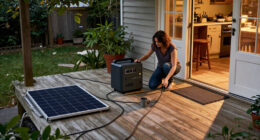
When systems combine solar, storage, and islanding controls, panels may recharge the battery during the outage. That depends on compatible equipment, settings, sunlight, and the battery’s charging limits. Ask the installer to show how the system behaves when the grid fails, rather than assuming that rooftop panels will keep producing.
Products Worth Considering

eufy Security Essential 7-Piece Alarm System with HomeBase Mini

Shark Pet Cordless Stick Vacuum, 40-Minute Runtime, Lightweight, IX141

Samsung 65-Inch S90H OLED 4K Smart TV Bundle with HW-B630F Soundbar, Subwoofer, and Screen Cleaner (2026)
As an affiliate, we earn on qualifying purchases.
Size the System Around the Appliances You Need Most
Choose backup capacity by listing the appliances you need, how much power they draw together, and how long you want them to run. Inverter output, measured in kilowatts (kW), limits the load you can use at one time; battery energy, measured in kilowatt-hours (kWh), indicates how long those loads can run. You need both figures to judge a system.
Start with the essentials: perhaps a refrigerator, internet equipment, a few LED lights, and a medical device. Then ask an electrician or installer to check their running loads and any startup surges, especially for motors and compressors. A refrigerator may use modest power while running but need a brief burst when its compressor starts.
Consider a simple illustration. Assume a usable 10 kWh battery and a combined backed-up load averaging 500 watts, or 0.5 kW. Dividing 10 kWh by 0.5 kW gives 20 hours on paper. This is a simplified estimate, not a runtime promise: conversion losses, temperature, battery reserve settings, changing appliance use, and solar recharge can all change the result.
Now add electric cooking, water heating, or central air conditioning. Those loads can drain stored energy quickly, and some require more inverter power than a small system can provide. Decide what you want to keep selected appliances or a whole home running through, then have a qualified installer check the home’s panel, wiring, and local electrical requirements. Backup wiring and transfer equipment are electrical work, not a casual DIY project.
Compare Essential-Circuit Backup With Whole-Home Backup
Essential-circuit backup powers a chosen group of important loads, while whole-home backup is designed to support more of the home within the system’s power and energy limits. A whole-home label does not mean every appliance can run together indefinitely. The system still has a finite inverter rating and battery capacity.
Picture a summer outage. A family using an essential-load setup might keep the fridge, router, a few lights, and a phone charger running, then cook on a gas hob and spend the warmest hours in a shaded room. A whole-home system might also support a heat pump or larger kitchen loads, but those appliances can need substantial continuous power and startup capacity.
| Backup choice | What it can suit | Main tradeoff |
|---|---|---|
| Selected circuits | Refrigeration, lighting, internet, and chosen critical equipment | Lower scope, with circuits and habits to manage |
| Broad or whole-home backup | More appliances, potentially including larger loads | Needs enough inverter output, storage, and installation capacity |
For many households, a carefully chosen essential-load plan is a practical starting point. If you rely on an electrically powered medical device, include it in the plan and ask about reserve settings and backup duration. For heating or cooling needs, have the installer assess the actual appliance and its starting surge; a generic “whole-home” claim cannot answer that for your house.
Estimate Outage Runtime Without Trusting a Guess
Runtime is the usable battery energy divided by the average power drawn by backed-up appliances, adjusted for the real conditions in your home. That simple calculation gives a starting estimate, not a guarantee. Weather, appliance cycles, conversion losses, battery reserves, and solar production can move the result.
Here is a practical sequence for a household that wants its refrigerator, router, lights, and a medical device backed up:
- List the circuits you want during an outage and note which devices will use them.
- Get the loads checked by a qualified installer, including startup surges and devices that cycle on and off.
- Set a target duration, such as overnight or a full day, and ask for a calculation using usable battery capacity.
- Ask about solar recharge during an outage, including cloudy-weather assumptions and reserve settings.
Suppose the combined average load is 0.5 kW and a battery offers 10 kWh of usable energy. The simplified estimate is 20 hours without solar recharge. If the household adds a high-draw electric kettle several times a day or runs air conditioning, its actual runtime falls; if the panels recharge the battery in clear weather, it may rise.
That is why an estimate should name its assumptions. Ask the installer to explain the load, usable capacity, reserve, and recharge conditions in plain language. A concrete estimate helps you decide whether to conserve power, add storage, or plan for another backup source.
Check Safety, Battery Details, and Local Rules Before Buying
A home battery needs certified equipment, suitable placement, and professional installation that follows local electrical and fire-safety requirements. Lithium iron phosphate (LFP) batteries have become more common in stationary storage because they offer long cycle life and favorable thermal stability compared with some other lithium-ion chemistries. Chemistry alone does not establish that a product or installation is safe.
Compare usable capacity, continuous and surge power, operating-temperature limits, warranty terms, safety certifications, and the installer’s support. A warranty may specify a number of years, a minimum capacity remaining, or a limit on energy throughput. Those details matter when you compare two systems with similar advertised capacity.
For instance, a homeowner with an unheated garage should ask how cold temperatures affect the battery and whether its controls limit charging in cold conditions. Another homeowner may care more about the replacement process and whether the installer will still service the equipment years later. Software updates and app monitoring can help you see battery state and solar production, but they do not replace a clear support plan.
Use a qualified installer for electrical work. A battery backup system may require permits, utility interconnection approval, panel changes, and approved transfer equipment. Never work on live wiring; power isolation and appropriate PPE belong in a professional safety plan.
Rules, utility policies, and available incentives vary by location and change over time. Check current local guidance instead of relying on an old price estimate or a national headline. A licensed professional can assess your wiring, panel capacity, placement, and permitting needs before you commit.
Separate Backup Protection From Electricity Bill Savings
Backup capability protects selected loads during an outage; electricity bill savings depend on your tariff, solar production, battery controls, and any local incentive program. A battery does not automatically lower your bill just because it stores solar energy. Your utility’s rate schedule and the system’s settings determine when stored energy has financial value.
For example, a household with time-of-use pricing may charge its battery from solar during the day and use stored energy during an expensive evening period. Another household with flat rates may get less bill benefit, even if the battery provides useful outage protection. Payback is not guaranteed, and local rates can change.
Some utilities or aggregators offer credits or payments for allowing a home battery to support the grid. Participation can affect how much energy remains reserved for your own outage, so read the program terms and choose a reserve setting that fits your risk. Smarter controls and app-based monitoring can make these tradeoffs easier to see, but they do not erase them.
Vehicle-to-home backup is also emerging. A compatible electric vehicle may supply household power through specialized bidirectional equipment, but a standard EV charger does not do this automatically. Before counting on a car as backup, confirm vehicle compatibility, equipment availability, installation requirements, and local approvals with a qualified provider.
Frequently Asked Questions
Will my solar panels work during a power outage?
Usually not by themselves. Most grid-connected systems shut down during an outage unless approved backup controls let them safely operate apart from the utility grid, often alongside a battery. Ask your installer to explain how your specific inverter behaves when the grid fails.
How large a battery do I need for my home?
Start with the circuits and appliances you want to back up, their power needs, and the number of hours you want them available. Then check both usable battery capacity in kWh and inverter output in kW, including startup surges. An installer can calculate a system around your actual loads.
How long will a home battery last in an outage?
It depends on usable capacity, the average load, solar recharge, weather, and any emergency reserve. As a simplified example, 10 kWh of usable storage divided by a 0.5 kW average load equals 20 hours before accounting for losses or changing use. Treat this as an estimate, not a guaranteed runtime.
Can a battery run central air conditioning or an electric stove?
Sometimes, if the inverter can handle the appliance’s continuous demand and startup surge and the battery holds enough energy. Those loads can drain storage quickly, so ask for an assessment based on the actual equipment in your home. A broad backup label alone does not prove that every large appliance can run at once.
Can solar panels recharge the battery during an outage?
Many systems can do this when their inverters and controls support islanded operation. Charging depends on sunlight, shading, weather, battery limits, and system settings. Ask for an explanation of expected charging in both clear and cloudy conditions.
Will a solar battery lower my electricity bill?
It may, depending on your utility rates, solar output, battery controls, and available programs. A battery can shift energy use to a less expensive time under some tariffs, but backup capability alone does not guarantee savings or a particular payback period.
Conclusion
Start with the loads you need to keep running, then match the inverter and usable battery capacity to those loads and the outage duration you expect. Ask a qualified installer to verify the electrical design, permits, placement, and local utility requirements.
A good backup plan is concrete: the fridge keeps its quiet hum, the router stays lit, and you know which switches to leave off when the sky turns gray.