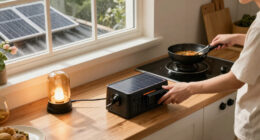
For most sheds, the 480W Off-Grid Solar Power Kit with a 100Ah LiFePO4 battery is the best overall balance of panel capacity, storage, and included inverter. The Renogy 400W Premium Solar Kit stands out for buyers who want an MPPT controller, while the ECO-WORTHY 200W starter kits suit lighter loads and smaller budgets. The main tradeoff is between a simpler, lower-capacity setup for lights and device charging and a larger system for tools or longer periods without sun. Battery capacity, inverter output, and whether a kit includes panels and essential components can matter as much as its wattage. Read on for the full comparison and guidance on choosing a kit that fits your shed’s actual loads.

Get backup power and energy gear delivered free with Prime
- Fast, free delivery on millions of items
- Prime Video, Amazon Music and more included
- Member-only deals all year
Key Takeaways
- The 480W kit is the strongest all-around fit: It pairs 480W of panels with a 100Ah LiFePO4 battery and a 1000W pure sine wave inverter, covering more shed uses than a basic panel-and-controller starter kit.
- Panel wattage alone does not determine usable power: The 100W and 200W options are better suited to light loads, while the larger systems pair more panel capacity with battery storage and inverter output for heavier demands.
- Controller type separates several midrange options: Renogy’s 400W kit includes MPPT, while multiple 200W kits use PWM controllers; the difference can affect charging performance and system design.
- Large off-grid kits may be more system than a shed needs: The 5kW and 1170W ECO-WORTHY systems are aimed at higher loads, so buyers should check their power plan before taking on a larger installation.
- Included components vary widely: Some picks include a battery and inverter, while others are starter kits centered on panels and controllers; compare the complete system needs, not just the headline wattage.
| 480W Off-Grid Solar Power Kit with 100Ah LiFePO4 Battery and 1000W Pure Sine Wave Inverter |  | Best Overall for Shed Power | Solar array: 480W total; 4 × 120W rigid monocrystalline panels | Battery: 100Ah, 12.8V LiFePO4 with built-in BMS | Battery energy: 1280Wh | VIEW LATEST PRICE | See Our Full Breakdown |
| 1280Wh Off-Grid Solar Panel Kit with 1000W Pure Sine Wave Inverter, 20A MPPT Controller, 100Ah Battery, and 240W Solar Panels |  | Best for Lower-Use Sheds | Solar array: 240W total; 2 × 120W rigid monocrystalline panels | Battery: 100Ah, 12.8V | Battery energy: 1280Wh | VIEW LATEST PRICE | See Our Full Breakdown |
| ECO-WORTHY 200W 12V Solar Starter Kit with Battery and Inverter |  | Best for Guided Setup | Solar array: 200W; 2 × 100W panels | Panel dimensions: 35.63 × 23.03 × 1.18 in | Panel weight: 11.5 lb | VIEW LATEST PRICE | See Our Full Breakdown |
| Renogy 100W 12V Solar Panel Starter Kit with 30A PWM Charge Controller |  | Best Expandable Starting Point | Panel power: 100W | System voltage: 12V | Controller capacity: 30A PWM | VIEW LATEST PRICE | See Our Full Breakdown |
| ECO-WORTHY 200W 12V Solar Panel Starter Kit with Battery and Inverter |  | Best Compact All-in-One | Solar array: 200W | Panel type: N-type monocrystalline | Panel efficiency: 25% | VIEW LATEST PRICE | See Our Full Breakdown |
| Renogy 400W Premium Solar Kit with 40A MPPT Charge Controller |  | Best for a Larger 12V Shed Setup | Total panel power: 400W | Panel configuration: 4 × 100W monocrystalline panels | Charge controller: 40A MPPT | VIEW LATEST PRICE | See Our Full Breakdown |
| Hoysicy 100W Solar Panel Kit with 20A Charge Controller |  | Best for a Simple 12V Shed Starter Setup | Panel power: 100W | Output voltage: 12V DC | Maximum voltage: 19.28V | VIEW LATEST PRICE | See Our Full Breakdown |
| ECO-WORTHY 200W 12V/24V Monocrystalline Solar Panel Kit with 30A PWM Charge Controller |  | Best Value for Flexible 12V or 24V Wiring | Maximum panel power: 200W | Panel configuration: 2 × 100W monocrystalline panels | System voltage: 12V or 24V | VIEW LATEST PRICE | See Our Full Breakdown |
| ECO-WORTHY 5kW Off-Grid Solar System Kit with 2,340W Panels, Inverter, and LiFePO4 Battery |  | Best for a Shed That Serves as a Small Off-Grid Workshop | Panel count and total power: 12 panels; 2,340W total | Inverter: 48V, 5,000W off-grid | Battery: 51.2V, 100Ah Cubix LiFePO4 | VIEW LATEST PRICE | See Our Full Breakdown |
| ECO-WORTHY 1170W Solar Panel Kit with 48V 3500W Off-Grid Inverter and 50Ah LiFePO4 Battery |  | Best Complete System for a Mid-Sized Shed | Solar panel output: 1,170W (6 × 195W) | Panel type and efficiency: N-type bifacial; 25% | Inverter output: 3,500W; 7,000W surge | VIEW LATEST PRICE | See Our Full Breakdown |
| ECO-WORTHY 400W 12V Solar Panel Kit with 2000W Inverter and Lithium Batteries | 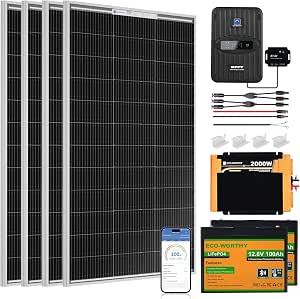 | Best for Higher-Power Shed Loads | Panel output: 400W total; 4 × 100W bifacial panels | Ideal daily energy output: 1.6 kWh under stated ideal conditions | System voltage: 12V | VIEW LATEST PRICE | See Our Full Breakdown |
| ECO-WORTHY 400W 12V Solar Panel Kit with 100Ah Lithium Battery |  | Best Value Complete Kit | Panel output: 400W total; 4 × 100W panels | Ideal daily energy output: 1.6 kWh under 4 hours of sunlight | System voltage: 12V | VIEW LATEST PRICE | See Our Full Breakdown |
| solar panel kits for shed | Panel dimensions | Charge controller | Battery | Inverter |
|---|---|---|---|---|
| 480W Off-Grid Solar Power Kit | — | 40A MPPT; 12V/24V auto-detection | 100Ah, 12.8V LiFePO4 with built-in BMS | 1000W pure sine wave; 2000W peak |
| 1280Wh Off-Grid Solar Panel Ki | — | 20A MPPT | 100Ah, 12.8V | 1000W continuous; 2000W peak, pure sine wave |
| ECO-WORTHY 200W 12V Solar Star | 35.63 × 23.03 × 1.18 in | 30A PWM | 12.8V, 100Ah lithium | 1100W |
| Renogy 100W 12V Solar Panel St | 43.58 × 22.72 × 2.95 in | — | — | — |
| ECO-WORTHY 200W 12V Solar Pane | 35.63 × 23.03 × 1.18 in | 30A | 12V, 50Ah LiFePO4 | 600W pure sine wave |
| Renogy 400W Premium Solar Kit | 41.8 × 20.9 × 1.38 in each | 40A MPPT | — | — |
| Hoysicy 100W Solar Panel Kit w | 20.1 × 1 × 39.8 in (listed) | 20A with LCD display and USB ports | — | — |
| ECO-WORTHY 200W 12V/24V Monocr | 35.2 × 23.1 × 1.3 in | 30A PWM | — | — |
| ECO-WORTHY 5kW Off-Grid Solar | 58.86 × 26.18 × 1.18 in each | — | 51.2V, 100Ah Cubix LiFePO4 | 48V, 5,000W off-grid |
| ECO-WORTHY 1170W Solar Panel K | 58.86 × 26.18 × 1.18 in each | — | 48V 50Ah LiFePO4; 2,560Wh usable energy | — |
| ECO-WORTHY 400W 12V Solar Pane | 35.63 × 23.03 × 1.18 inches | 40A MPPT | — | 2000W pure sine wave |
| ECO-WORTHY 400W 12V Solar Pane | 35.63 × 23.03 × 1.18 inches | 40A MPPT | 12V 100Ah lithium | 1100W pure sine wave, 12V DC to 110V AC |
More Details on Our Top Picks
480W Off-Grid Solar Power Kit with 100Ah LiFePO4 Battery and 1000W Pure Sine Wave Inverter
For a shed that needs both useful daytime generation and stored power after sunset, this kit offers the strongest balance in this group. Its 480W panel array is twice the size of the 240W array in the B0H3HNGLD6 kit, while the 100Ah LiFePO4 battery and 1000W pure sine wave inverter provide a ready-made 12V-to-120V setup for lights, chargers, and modest appliances. The MPPT controller can make better use of changing panel conditions than the PWM controller in the ECO-WORTHY 200W starter kit, though actual output still depends on sun and load. The tradeoff is that the 1.28kWh battery and 1000W inverter are not suited to large tools or extended heavy use. I’d choose it for a shed needing a capable, matched system without sizing up to a large off-grid installation.
Pros:- 480W of panels gives it more charging capacity than the 240W B0H3HNGLD6 kit.
- 100Ah LiFePO4 battery includes a built-in BMS for battery protection.
- 40A MPPT controller is better suited to harvesting solar energy than the PWM controller in the ECO-WORTHY 200W starter kit.
- Pure sine wave inverter supplies 120V AC for compatible electronics and small appliances.
Cons:- The 1.28kWh battery limits how long substantial loads can run without sunlight.
- A 1000W continuous inverter cannot support larger power tools or multiple heavy loads.
- Real-world generation varies with sunlight, location, season, and installation.
Best for: Shed owners powering lighting, electronics, and occasional modest appliances who want panels, battery, controller, and inverter in one package.
Not ideal for: People running high-draw workshop tools or expecting several days of heavy use, since the 1.28kWh battery and 1000W inverter limit runtime and load size.
- Solar array:480W total; 4 × 120W rigid monocrystalline panels
- Battery:100Ah, 12.8V LiFePO4 with built-in BMS
- Battery energy:1280Wh
- Inverter:1000W pure sine wave; 2000W peak
- Inverter conversion:12V DC to 120V AC
- Charge controller:40A MPPT; 12V/24V auto-detection
- Estimated daily generation:1.9–2.4kWh based on 4–5 sun hours
- Included mounting hardware:Four Z brackets, plus cables and Y-connector
Our verdict“Choose this kit for a shed needing a balanced, ready-to-assemble system for everyday light loads and modest AC equipment.”
1280Wh Off-Grid Solar Panel Kit with 1000W Pure Sine Wave Inverter, 20A MPPT Controller, 100Ah Battery, and 240W Solar Panels
This kit keeps the system format of the larger B0H7LYYM7L setup but cuts the panel array from 480W to 240W. That makes it a more restrained choice for a shed with a battery-backed lighting and charging setup, rather than a space where solar needs to replenish substantial daily use. It still includes a 100Ah battery and 1000W pure sine wave inverter, so its stored capacity and AC output rating look substantial beside the smaller array. The 20A MPPT controller supports energy management, but the product data does not identify the battery chemistry or specify charging time. Compared with the Renogy 100W starter kit, this is a more complete package with battery and inverter included; compared with the 480W kit, it will generally have less opportunity to recharge quickly. I’d pick it when the load is modest and a bundled system matters more than panel headroom.
Pros:- Includes panels, battery, inverter, MPPT controller, cables, and mounting brackets.
- 100Ah battery provides 1280Wh of stated storage.
- Pure sine wave inverter offers 120V AC output for compatible electronics.
- Rigid monocrystalline panels are described as weather-resistant.
Cons:- The 240W array offers less charging capacity than the 480W B0H7LYYM7L kit.
- Battery chemistry is not specified in the supplied product data.
- Charging time and real-world output are not specified and depend on conditions.
Best for: Shed owners who need a bundled battery-and-inverter system for lights, device charging, and occasional low-demand AC use.
Not ideal for: Owners who plan to use power daily for energy-hungry equipment or need faster battery replenishment; the 240W array is smaller than the B0H7LYYM7L kit’s.
- Solar array:240W total; 2 × 120W rigid monocrystalline panels
- Battery:100Ah, 12.8V
- Battery energy:1280Wh
- Inverter:1000W continuous; 2000W peak, pure sine wave
- Inverter output:120V AC
- Charge controller:20A MPPT
- Included hardware:Battery cables, PV extension cables, and Z-brackets
Our verdict“This is a sensible bundled choice for a modestly used shed, provided the smaller panel array can keep pace with your loads.”
ECO-WORTHY 200W 12V Solar Starter Kit with Battery and Inverter
The appeal here is a complete 200W starter system paired with four-step installation guidance, which gives first-time off-grid buyers a more directed starting point than the panel-and-controller-only Renogy 100W kit. It includes a 12.8V 100Ah lithium battery and an 1100W inverter, so the storage and inverter ratings are substantial relative to its modest panel capacity. That mismatch matters in a shed: the battery can hold 1.28kWh, but the 30A PWM controller and 200W array mean replenishing it may take time, especially in weak sun. The stated daily generation of up to 800Wh is condition-dependent, not a guaranteed yield. Compared with the ECO-WORTHY 200W kit with a 50Ah LiFePO4 battery, this one lists twice the battery capacity, but the controller is PWM rather than MPPT. I’d favor it when clear setup guidance and storage matter more than charging efficiency.
Pros:- Includes panels, 100Ah lithium battery, inverter, charge controller, and cables.
- Four-step installation guidance can help first-time off-grid installers.
- 1.28kWh stated storage exceeds the 50Ah battery capacity in the ECO-WORTHY B08MQGHWSZ kit.
- 1100W inverter rating supports compatible loads within the system’s limits.
Cons:- 30A PWM controller is a less efficient charging approach than MPPT in the B0H7LYYM7L and B0H3HNGLD6 kits.
- A 200W array may take time to replenish the 1.28kWh battery.
- Up to 800Wh daily generation depends on sunlight and installation conditions.
Best for: First-time shed solar buyers who want installation guidance and enough battery storage for lights, electronics, and intermittent small loads.
Not ideal for: Owners who need to refill a large battery quickly or maximize energy harvest in limited sunlight; its PWM controller is less efficient than the MPPT options here.
- Solar array:200W; 2 × 100W panels
- Panel dimensions:35.63 × 23.03 × 1.18 in
- Panel weight:11.5 lb
- Battery:12.8V, 100Ah lithium
- Energy storage:1.28kWh
- Inverter:1100W
- Charge controller:30A PWM
- Stated daily generation:Up to 800Wh, depending on conditions
Our verdict“Pick this kit if setup guidance and larger battery storage matter more than fast, efficient solar charging.”
Renogy 100W 12V Solar Panel Starter Kit with 30A PWM Charge Controller
Unlike the other complete systems in this group, this Renogy kit stops at the panel, controller, cables, and brackets; you supply the battery and any inverter. That makes it a less turnkey shed solution than the ECO-WORTHY 200W kit with battery and inverter, but it gives buyers room to choose storage around their actual needs. Its 100W panel is a practical entry point for basic 12V lighting or gradual battery charging, and the system can expand to 400W with compatible panels. The supplied PWM controller is simpler than the MPPT units in the B0H7LYYM7L and B0H3HNGLD6 kits, so this is not the pick for maximizing harvest from a compact array. I’d rank it for a shed owner building in stages, especially one who already owns a compatible battery. It is a poor fit if you want AC power ready out of the box.
Pros:- Expandable to 400W with compatible panels, giving staged shed installations room to grow.
- Compatible with AGM, gel, flooded, and lithium batteries.
- Includes panel, 30A controller, cables, and Z-brackets.
- Panel has stated 10-year materials-and-workmanship and 25-year power-output warranties.
Cons:- Battery and inverter are not included, unlike the ECO-WORTHY complete kits.
- 100W panel output is limited for regular appliance or workshop use.
- Remote monitoring requires a separately purchased Bluetooth module.
Best for: Shed owners who already have a compatible battery and want to start with a small 12V array they can expand toward 400W.
Not ideal for: Buyers wanting a ready-to-run AC system with battery and inverter included, or those seeking higher initial output than 100W.
- Panel power:100W
- System voltage:12V
- Controller capacity:30A PWM
- Cell efficiency:22.5%
- Average daily generation:500Wh, depending on sunlight
- Expandable capacity:Up to 400W with compatible panels
- Panel dimensions:43.58 × 22.72 × 2.95 in
- Panel weight:14.1 lb
- Battery compatibility:AGM, gel, flooded, and lithium
Our verdict“Choose this kit for a staged 12V shed setup if you already have storage and do not need an included inverter.”
ECO-WORTHY 200W 12V Solar Panel Starter Kit with Battery and Inverter
This ECO-WORTHY kit suits a small shed setup where integrated essentials matter more than maximum storage. It combines 200W of N-type monocrystalline panels, a 50Ah LiFePO4 battery, a 600W pure sine wave inverter, and a 30A controller. That is a smaller battery and inverter than the B0FWRK8JN6 kit, but the LiFePO4 chemistry is specified here and the lower inverter rating helps set realistic expectations for lights, chargers, and other modest loads. Its stated output of up to 800Wh per day depends on receiving four hours of suitable sunlight; it should not be treated as a daily guarantee. The inverter’s smart charger and UPS auto-switch add useful functionality, though the battery’s XT60 connection is limited to 30A input and output. I’d choose this over the 100W Renogy kit when a bundled battery and AC inverter are needed, but not for power-hungry tools.
Pros:- Includes 200W of panels, a LiFePO4 battery, charge controller, and pure sine wave inverter.
- N-type monocrystalline panels have stated 25% efficiency.
- Inverter includes a 30A smart charger and UPS auto-switch.
- LiFePO4 battery is rated for 4,000–15,000 deep-cycle recharges.
Cons:- 50Ah battery stores less energy than the 100Ah battery in the B0FWRK8JN6 kit.
- 600W inverter capacity is lower than the 1000W and 1100W alternatives.
- Battery XT60 interface is limited to 30A input and output.
Best for: Owners of compact sheds who want a bundled LiFePO4 battery and AC inverter for lighting, device charging, and low-demand equipment.
Not ideal for: People needing long runtimes, high-draw tools, or more than 600W of continuous inverter capacity; the 50Ah battery and 30A interface limit the system.
- Solar array:200W
- Panel type:N-type monocrystalline
- Panel efficiency:25%
- Battery:12V, 50Ah LiFePO4
- Inverter:600W pure sine wave
- Charge controller:30A
- Stated daily generation:Up to 800Wh under four hours of sunlight, depending on conditions
- Panel dimensions:35.63 × 23.03 × 1.18 in
- Battery interface limit:XT60 input and output limited to 30A
Our verdict“Choose this compact bundle for modest shed loads when you want specified LiFePO4 storage and an included inverter.”
Renogy 400W Premium Solar Kit with 40A MPPT Charge Controller
I’d shortlist this kit for a shed that needs more than occasional light or device charging but still uses a 12V battery system. Its four 100W panels provide twice the panel capacity of the ECO-WORTHY 200W kit, while the 40A MPPT controller and Bluetooth module give the owner more charging headroom and phone-based monitoring. The included brackets, cables, and adaptor kit also reduce the number of separate installation parts to source. The tradeoff is physical: four panels, each measuring 41.8 × 20.9 inches, need substantial roof or ground space, and the 56.4-pound kit is not a compact shed solution. I’d also verify the system-voltage details before buying, since the listed voltage fields are unclear, and the panel warranty is five years.
Pros:- Four panels provide 400W of rated solar capacity.
- 40A MPPT controller is included.
- Bluetooth module supports phone-based system monitoring.
- Z-brackets, cables, and adaptor kit are supplied.
Cons:- Four panels require considerably more mounting area than the 200W ECO-WORTHY kit.
- The listed maximum-voltage fields are unclear alongside the 32V maximum battery voltage.
- Five-year panel warranty is limited compared with buyers seeking longer stated coverage.
Best for: Shed owners with room for four panels and a 12V battery system who want higher solar capacity and phone monitoring.
Not ideal for: Owners of small sheds, buyers seeking a ready-to-use battery-and-inverter package, or anyone who needs clearly specified voltage compatibility without checking with the manufacturer.
- Total panel power:400W
- Panel configuration:4 × 100W monocrystalline panels
- Charge controller:40A MPPT
- Output voltage:12V
- Panel dimensions:41.8 × 20.9 × 1.38 in each
- Item weight:56.4 lb
- Connectors:MC4
- Included components:Bluetooth module, Z-brackets, adaptor kit, tray cable
- Panel warranty:5 years for materials and workmanship
Our verdict“Choose this Renogy kit for a spacious shed and a 12V system that needs more panel capacity than a 200W starter setup.”
Hoysicy 100W Solar Panel Kit with 20A Charge Controller
For a small shed with modest power needs, I’d favor this Hoysicy kit over the larger ECO-WORTHY 200W kit when straightforward 12V battery maintenance matters more than adding capacity. Its 100W panel comes with a 20A controller that has an LCD, USB ports, and built-in electrical protections, so the setup offers useful feedback and device charging without requiring a separate controller purchase. The included extension cables and mounting hardware also suit a basic off-grid installation. That simplicity comes with limits: it is designed for 12V batteries only, and 100W is a modest amount of solar input for tools or frequent appliance use. I’d check the panel dimensions before planning a roof layout, since the stated 1-inch measurement may need clarification. The two-year warranty is also shorter than the five years listed for the Renogy 400W kit.
Pros:- 20A controller includes an LCD display, USB ports, and electrical protections.
- Waterproof, corrosion-resistant panel construction uses an aluminum frame and tempered glass.
- Installation hardware and 16.4-foot extension cables are included.
- A compact 100W rating suits basic battery maintenance and light charging.
Cons:- Designed for 12V batteries, limiting system-voltage flexibility.
- 100W panel capacity is modest for regular tool or appliance use.
- Two-year warranty is shorter than the Renogy 400W kit’s stated panel warranty, and one listed dimension may need confirmation.
Best for: Owners of small sheds maintaining a 12V battery and seeking a modest panel kit with a display and USB charging.
Not ideal for: Buyers who need to run power-hungry tools, expand into a 24V system, or want a longer stated warranty.
- Panel power:100W
- Output voltage:12V DC
- Maximum voltage:19.28V
- Amperage capacity:5.19A
- Charge controller:20A with LCD display and USB ports
- Extension cable length:16.4 ft
- Panel dimensions:20.1 × 1 × 39.8 in (listed)
- Battery compatibility:12V batteries
- Warranty:2 years
Our verdict“Pick this kit for basic 12V battery upkeep in a small shed, but choose a larger system for regular appliance use.”
ECO-WORTHY 200W 12V/24V Monocrystalline Solar Panel Kit with 30A PWM Charge Controller
I’d choose this ECO-WORTHY kit when a shed needs more than a single 100W panel but doesn’t call for a complete inverter-and-battery package. Its two 100W panels offer double the rated panel power of the Hoysicy kit, and the option to wire them for 12V or 24V gives more flexibility when matching a battery system. That makes it a useful middle ground for lighting, charging, and other modest off-grid loads. The 30A controller, brackets, and cables are included, while the aluminum frames and stated wind and snow load ratings support outdoor mounting. Unlike the Renogy 400W kit, though, this is a 200W PWM setup, not a higher-capacity MPPT option. Its stated daily output assumes four hours of full sunshine, and the two panels need ample mounting space.
Pros:- Two 100W panels provide more capacity than the Hoysicy 100W kit.
- Panels can be wired for 12V or 24V systems.
- 30A PWM controller, Z-brackets, and solar cables are included.
- Aluminum alloy frame has stated wind and snow load ratings.
Cons:- PWM controller is a simpler option than the MPPT controller in the Renogy 400W kit.
- Panels need ample mounting space on a shed roof or nearby ground.
- The stated daily output depends on receiving four hours of full sunshine.
Best for: Shed owners who want a 200W panel array, need 12V or 24V wiring options, and already have or plan to supply a battery.
Not ideal for: Buyers needing an included battery and inverter, compact mounting, or dependable daily output regardless of local sun conditions.
- Maximum panel power:200W
- Panel configuration:2 × 100W monocrystalline panels
- System voltage:12V or 24V
- Charge controller:30A PWM
- Maximum voltage:27.4V
- Panel dimensions:35.2 × 23.1 × 1.3 in
- Weight:31.6 lb
- Wind and snow load:2400Pa wind load; 5400Pa snow load
- Warranty and support:1-year warranty; 24/7 technical support
Our verdict“Choose this kit for a flexible, mid-sized panel array when you can provide the battery and inverter separately.”
ECO-WORTHY 5kW Off-Grid Solar System Kit with 2,340W Panels, Inverter, and LiFePO4 Battery
This is a much larger commitment than the panel-and-controller kits in this group: I’d consider it when a shed is functioning as a workshop or a substantial off-grid space, not just a place for lights and charging. The package combines 2,340W of panels, a 48V 5,000W inverter, and a 51.2V 100Ah LiFePO4 battery, so it includes power conversion and storage that the Renogy 400W kit leaves to the buyer. Storage can make energy available after sunlight fades, while the inverter is intended for 120V loads. The drawback is scale. Twelve panels measuring 58.86 × 26.18 inches each demand extensive mounting area, and the system’s electrical and structural installation may call for experienced help. The inverter’s 5kW rating also exceeds the panels’ combined 2,340W rating.
Pros:- Complete package includes panels, inverter, LiFePO4 battery, cables, and Z-brackets.
- 2,340W of panel capacity is far greater than the Renogy 400W kit’s array.
- 100Ah LiFePO4 battery stores energy for use when panels are not generating.
- 5,000W inverter provides listed 120V AC output.
Cons:- Twelve large panels require substantial roof or ground area.
- Installation may require electrical and mounting expertise.
- The 5,000W inverter rating exceeds the panels’ 2,340W combined output.
Best for: Owners building a large off-grid shed or workshop who need battery storage and 120V output and have space for twelve panels.
Not ideal for: Small-shed owners with light loads, buyers seeking a simple battery-maintenance kit, or DIY installers without suitable electrical and mounting skills.
- Panel count and total power:12 panels; 2,340W total
- Inverter:48V, 5,000W off-grid
- Battery:51.2V, 100Ah Cubix LiFePO4
- Output voltage:120V
- Panel dimensions:58.86 × 26.18 × 1.18 in each
- Panel weight:21.9 lb each
- Panel efficiency:25%
- Included components:Panels, inverter, battery, cables, and Z-brackets
Our verdict“Choose this complete system only if your shed has substantial loads, room for twelve panels, and a properly planned 48V installation.”
ECO-WORTHY 1170W Solar Panel Kit with 48V 3500W Off-Grid Inverter and 50Ah LiFePO4 Battery
For buyers who want a shed system with storage and AC power but don’t need the twelve panels in ECO-WORTHY’s 5kW kit, this 1170W package is the more restrained choice. It pairs six 195W bifacial panels with a 48V inverter, built-in 80A MPPT controller, and a 50Ah LiFePO4 battery rated for 2,560Wh of usable energy. WiFi monitoring and UPS switching add useful system functions, while the battery’s stated cycle life supports repeated use. Still, the 3,500W inverter is much larger than the panel array’s 1,170W rating, so I’d match expected loads and charging needs carefully rather than treating its inverter capacity as available solar production. The panels are large, and the 58.4-pound battery adds installation weight. Compared with the 5kW kit, this needs fewer panels but provides less stored energy.
Pros:- Package includes panels, inverter, battery, cables, and mounting accessories.
- Built-in 80A MPPT controller and WiFi monitoring simplify system oversight.
- LiFePO4 battery is rated for 2,560Wh usable energy and more than 4,000 cycles.
- Six panels require less mounting area than the twelve-panel ECO-WORTHY 5kW kit.
Cons:- The 3,500W inverter rating substantially exceeds the 1,170W panel output.
- Large panels and a 58.4-pound battery call for careful space and mounting plans.
- Solar production varies with sunlight conditions, and packages may arrive separately.
Best for: Shed owners who need a battery-backed 48V system with 110/120V AC output, monitoring, and a smaller array than the 5kW ECO-WORTHY kit.
Not ideal for: Buyers with limited roof space, light-duty 12V needs, or loads that require more stored energy than the 50Ah battery provides.
- Solar panel output:1,170W (6 × 195W)
- Panel type and efficiency:N-type bifacial; 25%
- Inverter output:3,500W; 7,000W surge
- Inverter input voltage:48V DC
- AC output voltage:110/120V AC
- Built-in controller:80A MPPT
- Battery:48V 50Ah LiFePO4; 2,560Wh usable energy
- Battery cycle life:More than 4,000 cycles
- Panel dimensions:58.86 × 26.18 × 1.18 in each
Our verdict“Pick this kit for a shed needing integrated 48V battery storage and AC power, provided its array size and battery capacity match your actual loads.”
ECO-WORTHY 400W 12V Solar Panel Kit with 2000W Inverter and Lithium Batteries
For a shed that needs more than lights and device charging, this kit pairs 400W of bifacial panels with two 100Ah lithium batteries and a 2000W pure sine wave inverter. That larger inverter gives it more headroom for compatible AC tools or appliances than the 1100W inverter in the ECO-WORTHY 400W 12V Solar Panel Kit with 100Ah Lithium Battery. The included 40A MPPT controller and Bluetooth module also mean fewer major components to source separately. Its stated 1.6 kWh daily output assumes ideal conditions, though, and actual shed production will vary with sun, placement, and shading. The complete package is substantial for a small shed, and its 12V system may not suit buyers planning around another system voltage. Choose it for greater stored energy and inverter capacity, not for a minimal lighting setup.
Pros:- Includes four panels, two 100Ah lithium batteries, an MPPT controller, inverter, and Bluetooth module.
- Two lithium batteries provide more stated storage capacity than the companion 100Ah ECO-WORTHY kit.
- The 2000W pure sine wave inverter offers more rated output headroom than the companion kit’s 1100W inverter.
- Battery cycle life is rated at more than 3,000 deep cycles.
Cons:- The 1.6 kWh daily output is an ideal-conditions figure, not a guaranteed shed yield.
- The 12V system may not fit buyers who need a different system voltage.
- The larger battery and inverter package may be more equipment than a basic shed lighting setup needs.
Best for: Shed owners who want an all-in-one 12V setup with more battery storage and inverter capacity for several compatible AC loads.
Not ideal for: Owners powering only a few lights or small electronics, or anyone building a system around a voltage other than 12V.
- Panel output:400W total; 4 × 100W bifacial panels
- Ideal daily energy output:1.6 kWh under stated ideal conditions
- System voltage:12V
- Batteries:2 × 12V 100Ah lithium
- Charge controller:40A MPPT
- Inverter:2000W pure sine wave
- Battery cycle life:More than 3,000 deep cycles
- Panel dimensions:35.63 × 23.03 × 1.18 inches
Our verdict“Choose this kit over the 100Ah ECO-WORTHY model if your shed needs more battery storage and higher inverter capacity in one package.”
ECO-WORTHY 400W 12V Solar Panel Kit with 100Ah Lithium Battery
This kit covers the main components for a shed solar setup—400W of panels, a 100Ah lithium battery, a 40A MPPT controller, and a pure sine wave inverter—without the second battery included in its 2000W ECO-WORTHY sibling. That makes it a better fit for buyers who want a complete package but do not need as much stored energy or inverter capacity. Its 1100W inverter is rated below the sibling’s 2000W unit, so check the starting and running requirements of any AC equipment before choosing it. The stated 1.6 kWh daily output assumes four hours of sunlight; shade, season, and panel orientation can reduce real production. With a 12V configuration and one battery, this is a more restrained package, but not a tiny or expandable-by-default starter system.
Pros:- Includes the panels, lithium battery, MPPT controller, inverter, Bluetooth module, and accessories.
- The 400W array is paired with a 12V 100Ah lithium battery for a complete off-grid package.
- Pure sine wave inverter provides 110V AC output for compatible equipment.
- Battery is rated for more than 3,000 deep cycles and includes a built-in protection system.
Cons:- The 1100W inverter offers less rated capacity than the 2000W inverter in the other ECO-WORTHY 400W kit.
- One 100Ah battery provides less storage than the sibling kit’s two-battery configuration.
- The stated 1.6 kWh daily output depends on four hours of sunlight and ideal conditions.
Best for: Shed owners who want panels, storage, controller, and inverter together for lights, charging, and modest AC loads.
Not ideal for: Buyers expecting to run higher-demand AC equipment or wanting the extra battery storage and 2000W inverter of the other ECO-WORTHY 400W kit.
- Panel output:400W total; 4 × 100W panels
- Ideal daily energy output:1.6 kWh under 4 hours of sunlight
- System voltage:12V
- Battery:12V 100Ah lithium
- Charge controller:40A MPPT
- Inverter:1100W pure sine wave, 12V DC to 110V AC
- Battery cycle life:More than 3,000 deep cycles
- Panel dimensions:35.63 × 23.03 × 1.18 inches
- Manufacturer warranty:1 year
Our verdict“Pick this kit for a complete 400W shed system with moderate loads, and choose its 2000W sibling if you need more inverter capacity and battery storage.”

How We Picked
I ranked these kits by how well their stated components match common shed jobs, from running lights and charging devices to supporting tools or more sustained off-grid use. I weighed panel capacity alongside battery storage, inverter output, and charge-controller type, since any one of those can limit a system even when the other specifications look generous. I also considered how much of a usable setup each product appears to include, the flexibility implied by its design, and whether its scale makes sense for a typical shed.
The ranking favors balanced kits with useful storage and an inverter over panel-only starter options when the goal is a broadly capable shed system. Smaller kits remain higher-value fits for low-power use, while larger systems rank for buyers who can make use of their additional capacity. Product names and listed specifications provide the basis for comparison; actual output depends on sunlight, installation, loads, and component compatibility. I do not treat a larger system as automatically better, because excess capacity can add installation and planning demands without helping a lightly used shed.
Factors to Consider When Choosing Solar Panel Kits For Sheds
Before choosing a kit, start with the shed’s daily jobs rather than its roof size or a single wattage figure. These factors can help you avoid buying a setup that cannot start a tool, runs out of stored energy overnight, or includes equipment you do not need.
1. List Loads and Their Run Time
Write down each device, its wattage, and how many hours you expect to use it on a typical day. Add up watt-hours for energy needs, but keep peak demand separate because motors and some tools draw more power when starting. A lighting-and-phone-charging shed can fit a much smaller system than a space running a compressor, saw, or refrigerator. Avoid sizing from the largest appliance’s label alone: several small loads running for hours can use more energy overall. If your use changes by season, size around the busiest period you actually plan to support. This load list also helps identify jobs that are better handled by a separate battery tool or a grid connection than by expanding a solar kit.
2. Match Battery Storage to Use After Sunset
Panels generate energy during daylight; the battery determines how much of that energy remains available later. Compare battery capacity with your overnight and cloudy-day needs, not just the panel rating. A system with ample panels but modest storage may work well for daytime use yet leave lights or devices without power after dark. Battery chemistry, usable capacity, cold-weather limits, and the manufacturer’s charging guidance all affect the real fit. Leave room for cloudy periods if the shed is remote and downtime would matter, but avoid paying for several days of storage when loads are occasional and nonessential. Check that the battery is compatible with the controller and inverter before combining components.
3. Check Inverter Capacity and Waveform
DC lights and USB devices may not need an inverter, while many household-style AC tools do. For AC equipment, compare the inverter’s continuous output with the combined load and check its surge rating against motor-start demands. A pure sine wave inverter is often the more compatible choice for sensitive electronics and some appliances, but its capacity still needs to match the job. A large inverter cannot compensate for undersized panels or a small battery; it can simply make high loads possible briefly before stored energy runs low. Also check whether the kit includes the inverter at all, since several starter-style products list a controller and panels but not a complete AC power path.
4. Treat Controller Type as a System Choice
PWM controllers can be a straightforward match for some smaller, simpler systems, while MPPT controllers can make better use of panel voltage in suitable configurations. The right choice depends on panel specifications, battery voltage, temperature, and wiring—not just the controller label. Confirm the controller’s maximum solar input and charging current against the array you plan to install. Do not assume that a kit described as 12V or 24V automatically supports every battery or panel arrangement at those voltages. If you might expand later, check the controller’s limits before buying; adding panels beyond its capacity can require replacing a central component. A well-matched smaller controller is preferable to a nominally advanced one paired with incompatible equipment.
5. Plan the Roof, Wiring, and Weather Exposure
Measure usable roof area and check its orientation, shade, and structural condition before choosing panel count. Trees, vents, and nearby buildings can cut production, so a compact array in a sunny location may outperform a larger shaded one. Decide whether panels belong on the shed roof or a ground mount, where they will be easier to clean and maintain. Include cable distance in the plan: longer runs can create voltage drop, and outdoor wiring needs suitable ratings, protection, and secure routing. Keep batteries and electronics within their specified temperature and moisture limits rather than assuming a shed is a safe enclosure. Follow local electrical rules and manufacturer instructions, especially when the system is permanently mounted or tied to building wiring.
6. Buy for Real Capacity, Not Expansion Hopes
Paying more for a larger kit makes sense when your measured loads, storage needs, and roof space can use the added capacity. It is less useful when your only needs are occasional lights and device charging, particularly if the larger system also brings more installation work and components to maintain. Before paying for an all-in-one bundle, check what is included and what must be purchased separately, such as mounting hardware, wiring, fuses, or battery connections. If future expansion matters, verify compatible voltage ranges and controller capacity instead of assuming panels or batteries can be added freely. A modest system that matches current use can be a better starting point than an oversized kit selected on the promise of flexibility.
Frequently Asked Questions
Can a 100W or 200W kit run power tools in a shed?
It depends on the tool’s running and startup demand, the inverter, and how long you need to run it. A 100W or 200W panel rating describes solar input under suitable conditions, not the power the system can supply at every moment. Check the inverter’s continuous and surge ratings, then compare them with the tool’s label or manual. The battery also needs enough usable energy for the planned work, especially if you will operate tools after sunset or during cloudy weather. For regular use of demanding tools, a small starter kit may be better reserved for lights and charging.
Is a kit with an included battery and inverter better than a panel starter kit?
An all-in-one-style bundle can reduce the number of separate components you need to source, but it is not automatically the better fit. Check whether its battery and inverter match your loads, and confirm which wiring, protection, and mounting parts are included. A panel-and-controller starter kit can suit a buyer who already owns compatible equipment or wants to build a system in stages. That route also requires more care with voltage, current, and component compatibility. Compare the cost and effort of completing each setup rather than treating included component count as a measure of value.
Will the listed panel wattage be available on a cloudy day?
No panel rating should be treated as guaranteed daily production. Output changes with cloud cover, season, panel angle, shading, temperature, and installation conditions. A shed that needs dependable power through poor weather may need more panel capacity, more battery storage, or a backup source, depending on its loads. Think in terms of energy over several days rather than assuming the array will produce its rated wattage throughout the day. For critical equipment, plan for reduced solar output instead of sizing the system around ideal conditions.
Can I add panels or batteries to one of these kits later?
Sometimes, but expansion depends on the controller, inverter, battery chemistry, voltage, and wiring limits. Check the maximum solar input and charging current before adding panels, and follow the battery maker’s rules for adding capacity. Mixing batteries of different ages, capacities, or chemistries can create performance and safety issues. Panel expansion may also require a different series or parallel configuration, suitable cable sizing, and additional protection. If growth is likely, choose a system with documented expansion limits rather than relying on the assumption that every component can be upgraded independently.
Should I choose a larger 5kW-class system for a shed to allow room to grow?
Only if your planned loads and site can use that scale of system. A larger array and inverter can support more demanding use, but they also bring more installation planning, wiring, mounting, and component-matching work. For a shed used mainly for lighting and charging, extra capacity may sit idle while adding complexity. First list current loads and realistic near-term additions, then check roof or ground space and battery storage needs. If you expect substantial growth, compare the complete system requirements rather than selecting a large kit based on its headline output alone.
Conclusion
For a balanced shed setup with panels, storage, and an inverter, I’d start with the 480W Off-Grid Solar Power Kit as the best overall pick. The Renogy 400W Premium Solar Kit is my best value choice for buyers who prioritize an MPPT-based midrange system, while the ECO-WORTHY 200W starter kits are the most approachable starting point for light loads—check the listed components carefully, since similarly named options may differ. For high-demand or expansion-focused use, the ECO-WORTHY 5kW Off-Grid Solar System Kit is the best premium-scale option, provided your loads and installation justify it. If you need a compact setup, look at the 100W choices; if your shed needs sustained power for larger loads, compare the 1170W and 5kW systems against a detailed load plan. The right choice is the smallest complete system that can reliably handle the jobs you actually expect it to do.